
★★★☆☆
Credit: Millie Hine
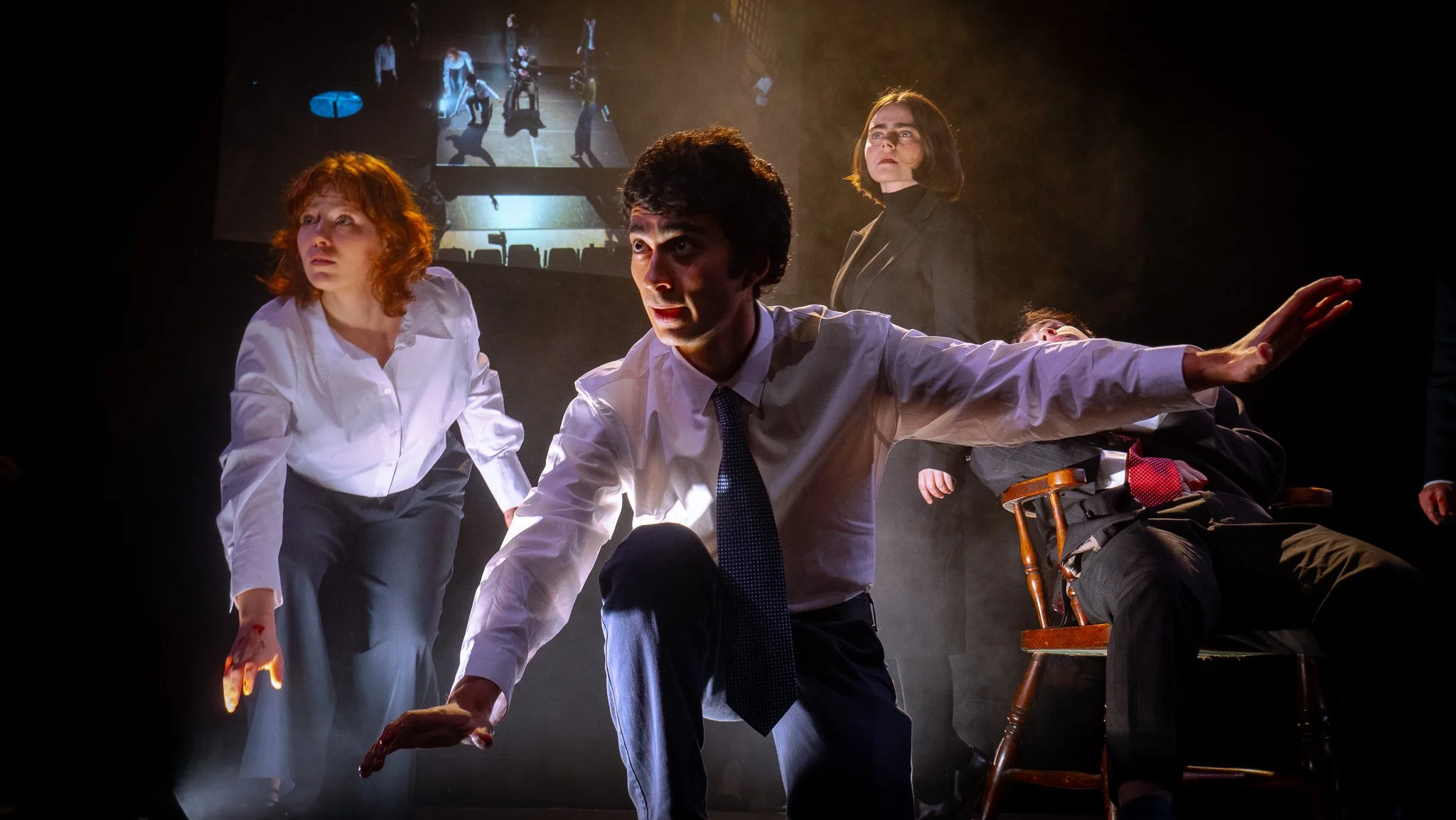
As I walked into the Fitzpatrick Hall at Queen’s College, I was greeted by an usher who explained to the audience members that standing up to watch William Shakespeare’s Julius Caesar would provide the spectator a more ‘immersive experience’. There was, accordingly, a series of retractable belt barriers arranged around the square stage space. These blended the original Shakespearean Globe theatre standing experience with a modern red-carpet like meet-and-greet. From the business wear costume to the use of the film camera, this production of Julius Caesar is avowedly modern.
At the opening of the play, the actors burst onstage to electronic dance music booming around the theatre. They high-fived us spectators, they blew party blowers in our faces and danced about raucously - hardly behaviour which situated me in 1st century BC Rome. When the man himself, Caesar, entered, he waved, smiled and acknowledged the super-fans stood behind the barriers. He was followed by a film camera, projecting his face onto the screens around him.
This multimedia experience was central to this production and imbued the millennia old plot of political intrigue, and Shakespeare’s multiple century old play with a modern edge. The stage space itself was framed by one large screen towards the back and two small televisions which projected the live footage from the camera onto them. Each man in power controlled the view of the camera when it was his moment in the limelight. The focus changed from Caesar to Brutus to Antony; when the house lights finally dimmed at the end of the play the camera held a long still shot on Octavius, the future emperor Augustus and the eventual winner at the end of the power struggle. The presence of the camera mimicked the manner in which modern politics has evolved into a reality-TV like spectacle; the camera shines on the man or woman of the moment.
Meta-theatricality was certainly at the fore of Julius Caesar, and was partly its most rewarding aspect. At times the camera created a mise-en-abyme black-hole like set of infinitely recurring reflections. Shortly after the death of Caesar, the camera panned to Mark Antony (Dylan Hughes) who stood in front of the large screen. It presented the audience with frame on frame ad infinitum, mirroring the chaotic collapse of the Roman Republic. It must be acknowledged that occasionally the camera did appear a cumbersome accessory to the stage, as the operator blocked moments of action and even stumbled upon the plastic knives used to stab Caesar discarded on the stage floor.
Credit: Millie Hine
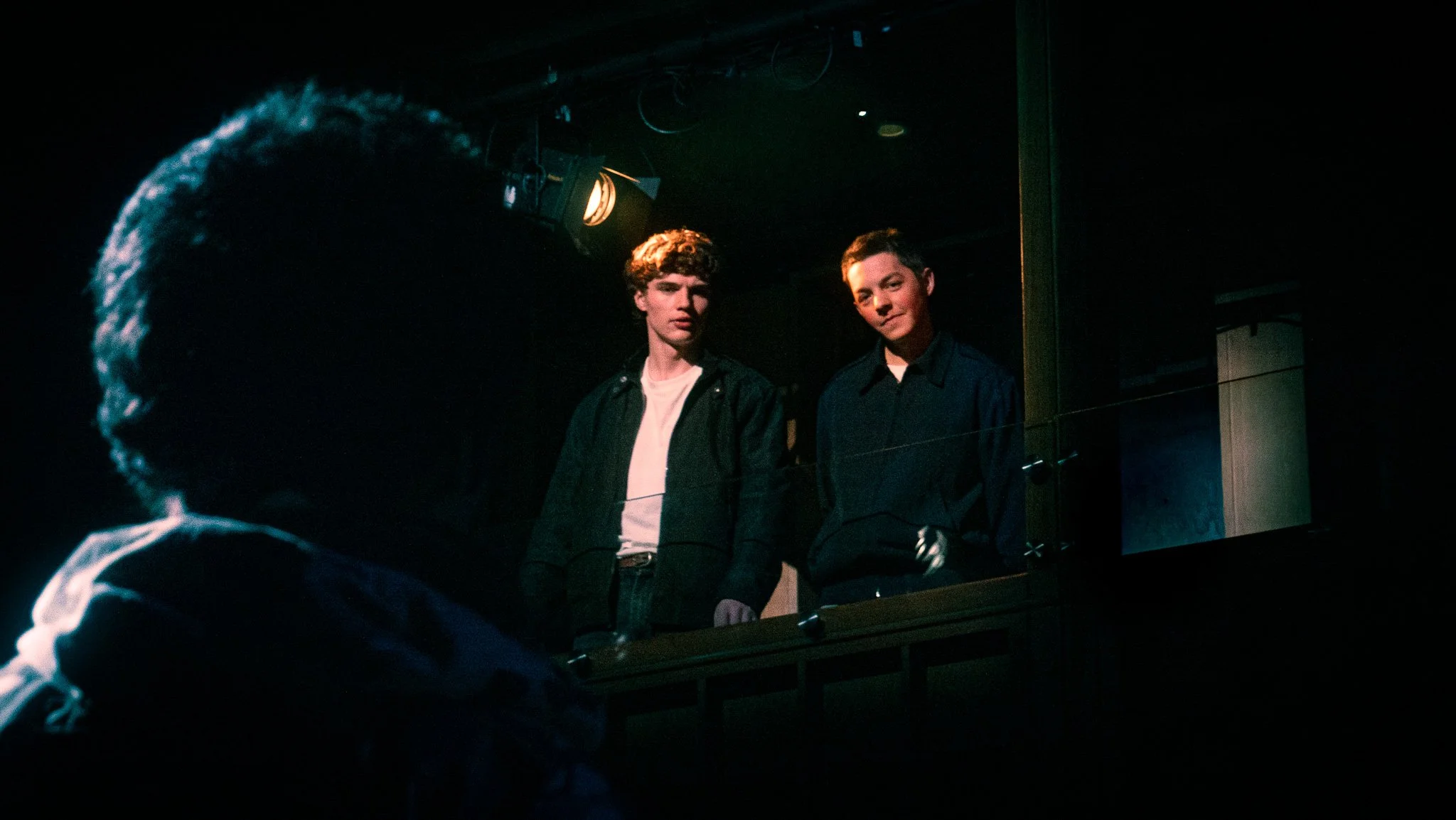
When the camera operator exited the stage at several points during the play, her absence captured the conspiracy and connivances rooted in Julius Caesar and separated the public from the private. Cassius, brilliantly played by Violette Chereau, and Brutus (Eddie Luchmun) conspired in the absence of onlookers. Luchmun emotively portrayed Brutus’ Medea-like wavering and unresolvedness in his personal study, away from the camera. At other times, he remained poised and thoughtful. The extent to which this was aided by the continual repetition of him taking on-and-off his glasses is up for debate. Chereau exceptionally breathed life and freshness into the Shakespearean language; at times she made the 16th century English sound like modern dialogue. Julius Caesar, as enacted by Jonah Woods, had an exceptional timbre of voice which elegantly captured the over-confident tone of man about to be killed for his excessive power.
Possibly the most moving moment of Julius Caesar, was the scene between the married couple, Portia (Mia Lomer) and Brutus. It was an exceptional portrayal of the frustration of a wife who feels excluded from her husband’s internal world. The visual contrast in the costuming of Portia’s silk pyjamas and Brutus’ work-attire was particularly emotive as they disputed in the late hours of the night. Another brilliant choice was Gabriel Castelli as Octavius. He perfectly captured the youthfulness of a young buck attempting to fill the shoes of his recently killed father, Julius Caesar, which provided a comic force to the intensity of the second half of the play.
Julius Caesar contains an interval, though the split between the two halves was rather disjointed. The first half was long (circa 1.5 hours) and it was clear that audience members, both standing and seated, were visibly growing restless. Other audience members and I further struggled to tell whether it was an interval or just an ambiguous end to the play; I overheard much confusion. Consequently, spectators were also unaware of the length of the interval, and when the second half commenced people stumbled back to their seats in dribs and drabs with drinks from the bar; it became a distracting experience. Perhaps, this was just an oversight upon an otherwise smooth-sailing opening night.
This production was certainly innovative and thoughtful. For me, I enjoyed a post-show pint at the Granta with other theatre-goers who were highly laudatory of Julius Caesar, and I hope that as many of you as possible went to watch the production at the Fitzpatrick Hall from November 19-22nd.