
On 15 February 2003, up to two million people marched through London carrying placards declaring “Not in My Name”, “Make Tea, Not War” and, rather more succinctly, “NO”. They were part of an unprecedented global mobilisation, with demonstrations across some 800 cities, from Rome to Madrid, to Sydney, to Damascus.
Less than five weeks later, Britain invaded Iraq.
It was the largest political demonstration in British history. Yet it failed to achieve its most obvious goal. When asked why his book Violent London: 2000 Years of Riots, Rebels and Revolt covered the march only in passing, historian Clive Bloom replied: ‘There is no story there. There is nothing you can write about’.
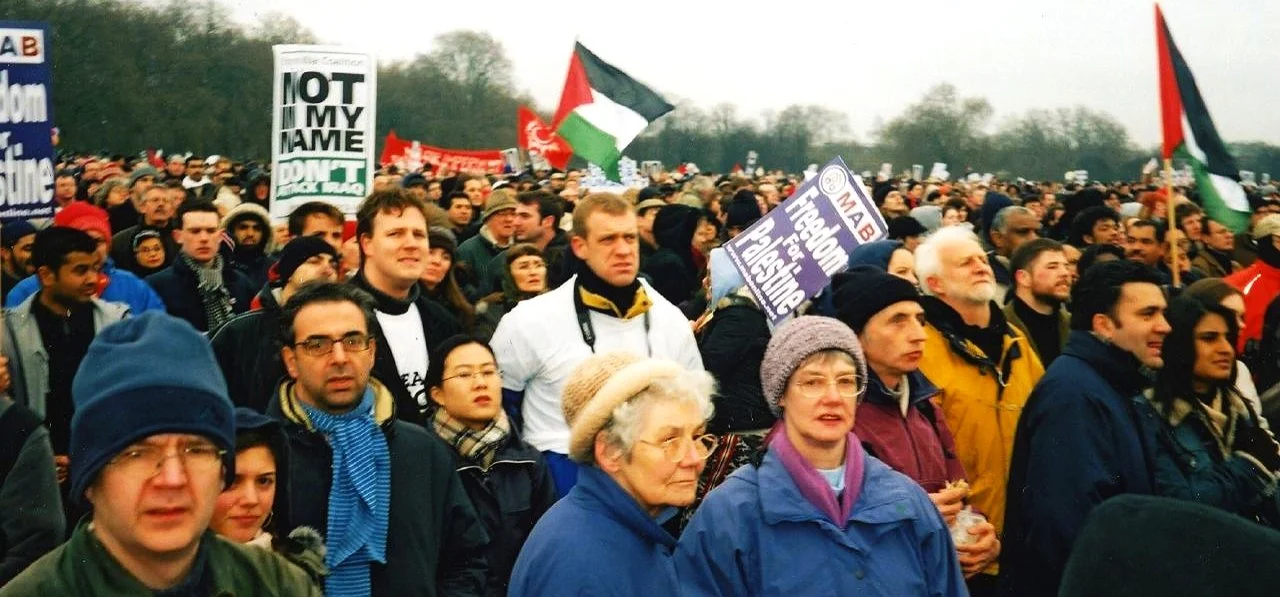
Anti-war protesters in London on February 15, 2003. Credits: Ben Sutherland (Creative Commons 2.0)
But perhaps the key problem here is how we define failure.
Following the September 11 attacks, US President George W. Bush had turned his attention to Saddam Hussein, whose alleged possession of weapons of mass destruction became the justification for invasion. British Prime Minister Tony Blair committed Britain to the campaign despite mounting opposition.
While protesters filled London's streets, Blair was addressing a Labour Party conference in Glasgow. Two competing visions of Britain's national interest were being articulated simultaneously: one by its elected government, the other by citizens insisting that the government did not speak for them.
The war went ahead. No stockpiles of weapons of mass destruction were found. In 2016, the Chilcot Inquiry concluded that Britain had invaded before peaceful alternatives had been exhausted, and that the threat posed by Iraq had been presented with unjustified certainty.
Yet reducing February 2003 to a failed attempt to prevent war misses something more interesting. The protesters were not simply arguing about what Britain should do. Many were challenging what Britain should be.
Opposition extended well beyond London’s streets. Ipsos polling conducted between 28 February and 2 March 2003 found that 67% of respondents opposed military action against Iraq, compared with just 24% in support. The gulf between the government and the governed was not merely symbolic.
The movement's diverse composition gave that opposition a public face. The Stop the War Coalition, established in 2001 and rooted in the British left, joined forces with the Campaign for Nuclear Disarmament (CND), a veteran of Britain's peace movement, and the Muslim Association of Britain (MAB). Together, they mobilised a remarkably broad cross-section of British society: secular socialists, religious campaigners, trade unionists, pacifists and first-time demonstrators.
By bringing together different political traditions, religious communities and generations, the alliance embodied a plural Britishness that challenged the government's claim to represent the national interest.
Opposition also took shape in local communities. In New Milton, Hampshire, Ann Fannin recalled how she and her friend Joyce, two women in their sixties, printed a petition and stood outside their local Safeway collecting signatures. Such modest acts of participation connected everyday life to a national mobilisation.
Reporting for The Guardian, Euan Ferguson captured the diversity of those marching: “There were nuns. Toddlers. Barristers. The Eton George Orwell Society. Archaeologists Against War…it is safe to say that they had never experienced such a mass of humanity’’.
That alternative vision of British identity was articulated in the movement's visual language. Placards reading “Not in My Name” rejected the assumption that government action automatically expressed popular consent, while “Make Tea, Not War” appropriated a familiar symbol of Britishness to suggest that opposition to invasion was not unpatriotic, but consistent with the nation's values.
David Gentleman's now iconic “NO” poster, designed for the February demonstration, incorporated different objections to the invasion within the enormous letter “O”. Like the coalition itself, the poster's power lay in expressing collective opposition without requiring identical convictions.
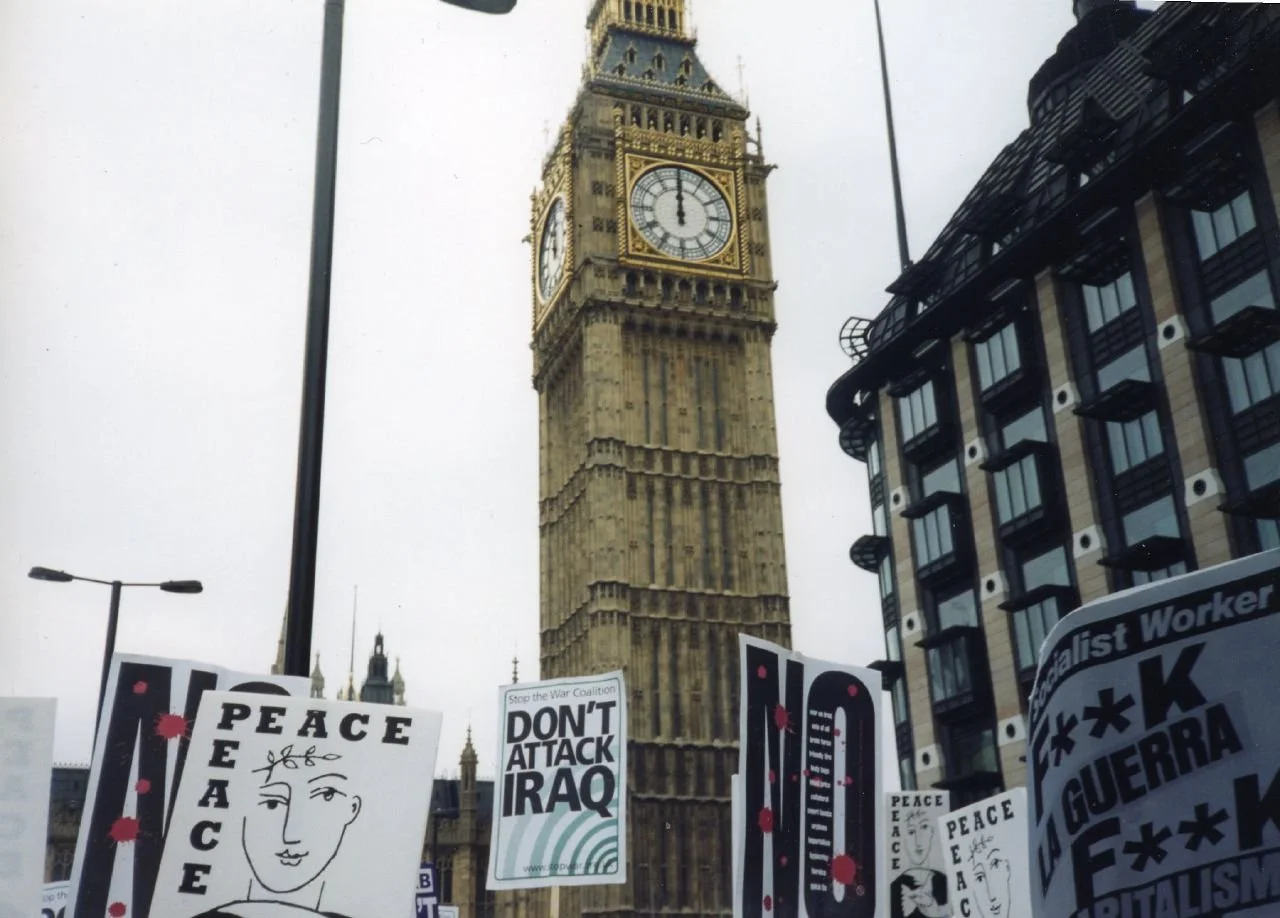
Anti-war placards at Big Ben (Gentleman’s ‘NO’ is visible). Credits: Ben Sutherland (Creative Commons 2.0)
For some, this was more than a political statement; it was an experience of national belonging. Haifa Zangana, an Iraqi writer living in exile, recalled the demonstration as “one of the few times I have felt at home in Britain”. Mundher al-Adhami, another Iraqi participant, described it as “the real Britain”. As their country faced British invasion, both found a Britain with which they could identify among those opposing the war.
Twenty-three years later, that contest over who speaks for Britain has hardly disappeared.
Speaking to The Cambridge Student, a Stop the War Coalition spokesperson explained that February 2003 “has very much shaped our identity and campaigning ever since”. The Coalition continues to organise opposition to British foreign policy, most visibly through its involvement in demonstrations over Gaza. The Coalition marks its 25th anniversary this year, which, as the spokesperson observed, “isn’t really a matter for rejoicing, since it means 25 years of war.”
Today, the Coalition continues to work alongside Muslim organisations, Palestinian solidarity groups, anti-nuclear campaigners and trade unions, preserving something of the unlikely alliance that came together in 2003. In this way, Stop the War still sees itself as articulating an alternative vision of Britain's national interest.
Perhaps the more enduring question is not why millions of people failed to stop a war, but what their mobilisation reveals about the possibilities and limits of popular dissent. The protesters could not determine Britain’s foreign policy, but they could challenge the assumption that its government spoke for the nation without contest.
To remember the anti-Iraq War movement solely for what it failed to prevent is to allow the government’s actions to define the historical significance of those who opposed them. The movement may have failed to prevent war, but that does not mean it failed to make history.