
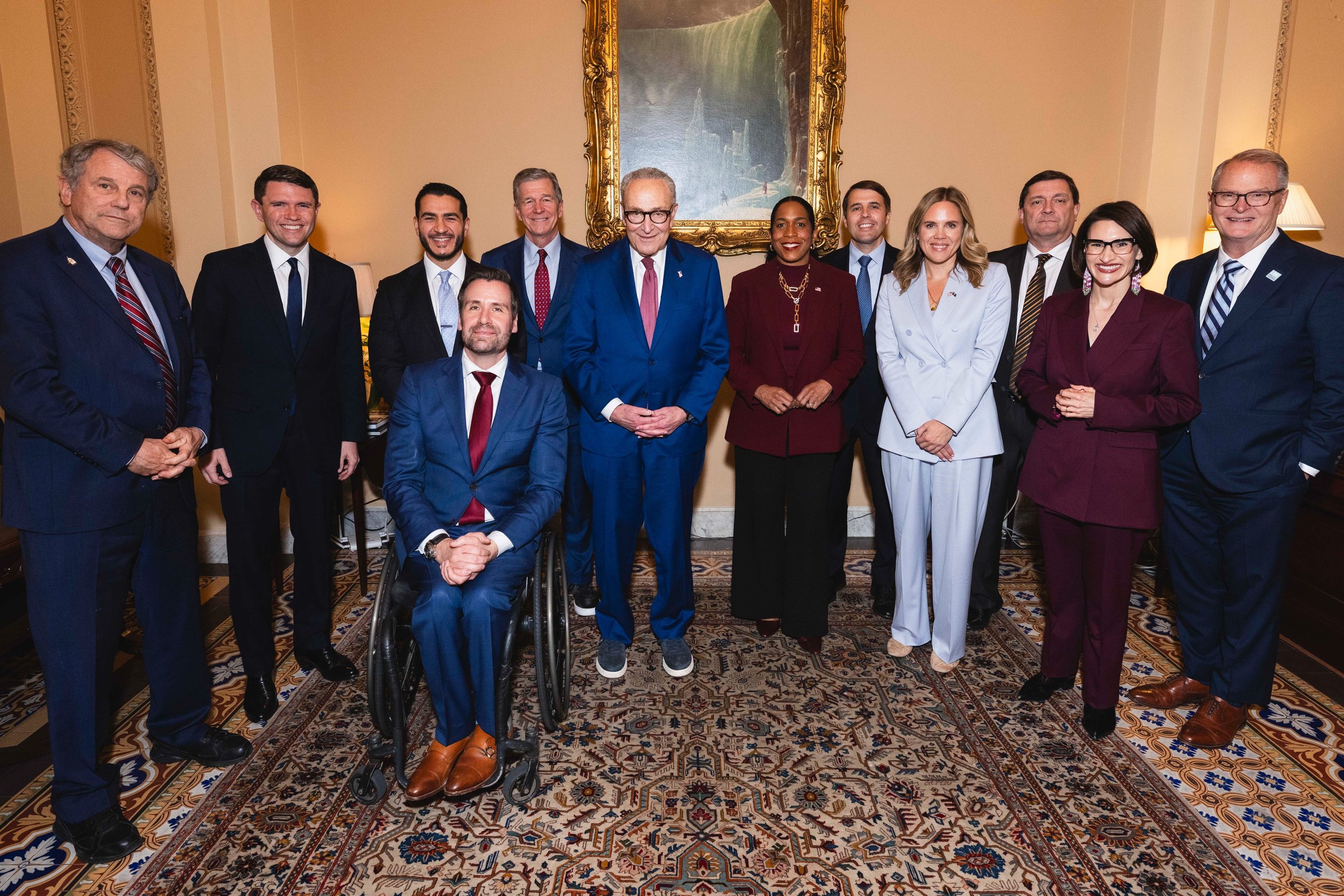
The 2026 class of Democrat senators meet with Senate Democratic Caucus leader Chuck Schumer. U.S. Senate, Public domain, via Wikimedia Commons
In the run-up to the 2026 midterms, the Democrats appeared to occupy a favourable position amongst the electorate vis-à-vis the Republicans, with the latter increasingly disgraced by the deeply unpopular war with Iran, a rampant cost-of-living crisis and public outrage over violent ICE raids and the release of the Epstein files. As Trump’s approval ratings plummeted, the Democrats, refusing to repeat the mistakes of the 2024 Presidential election, looked towards Congress with optimism. In so doing, what was initially projected to be a blue wave crashed with the force of a tsunami, sweeping away even the strongest Republican strongholds in its wake.
In the aftermath of the midterms, the Democrats secured sizable majorities in the House and Senate respectively. Republican efforts to redraw congressional maps in their favour faltered across the South, most notably in Texas, wherein a map designed to deliver five additional Republican seats instead produced a net gain of one for the Democrats. In the Senate, the Democrats likewise won a seat in Texas for the first time since 1988, Kansas for the first time since 1932, Mississippi for the first time since 1982, and South Carolina for the first time since 1998, with concurrent gains in Iowa, North Carolina, Ohio and Maine. This is not to mention pending results in Alaska, in which Democrats are leading the vote counts and look set to flip the ruby red Republican seat. The outcome produced a run of historic firsts, not least among them the elections of Abdul El-Sayed in Michigan, the country’s first Muslim senator and Deb Haaland in New Mexico, the country’s first Native American governor.
Adam Hamilton’s victory in Kansas is the first by a Democrat running for the Senate in that state since 1932, when Franklin Roosevelt’s landslide victory in the Presidential election galvanised a political realignment that would durably hold for the better part of half a century, reaching into states that the Republicans hitherto held firm. Having beaten the former Congressman Chauncey B Little by roughly two votes to one in that summer’s Democratic primary, George McGill unseated the former Republican governor Ben Paulen in November. Ninety-four years later, Hamilton similarly succeeded in persuading enough ardent Republicans to support him, notwithstanding that his election would not only entail the defeat of his Republican opponent but also help deliver control of the Senate to the Democrats.
Trump’s growing unpopularity, compounded by the tariffs, the Epstein files and the cost of living, accounts for much of that defeat; though the Democrats appear to have found something of a winning formula for tight races across the countries, built largely by the quality of the candidates they selected. In Texas, for instance, James Talarico centred his campaign on a progressive Christianity suited to reliably Republican and devoutly religious states, thereby acquiring something of a cult following after a campaign that circulated widely across social media.
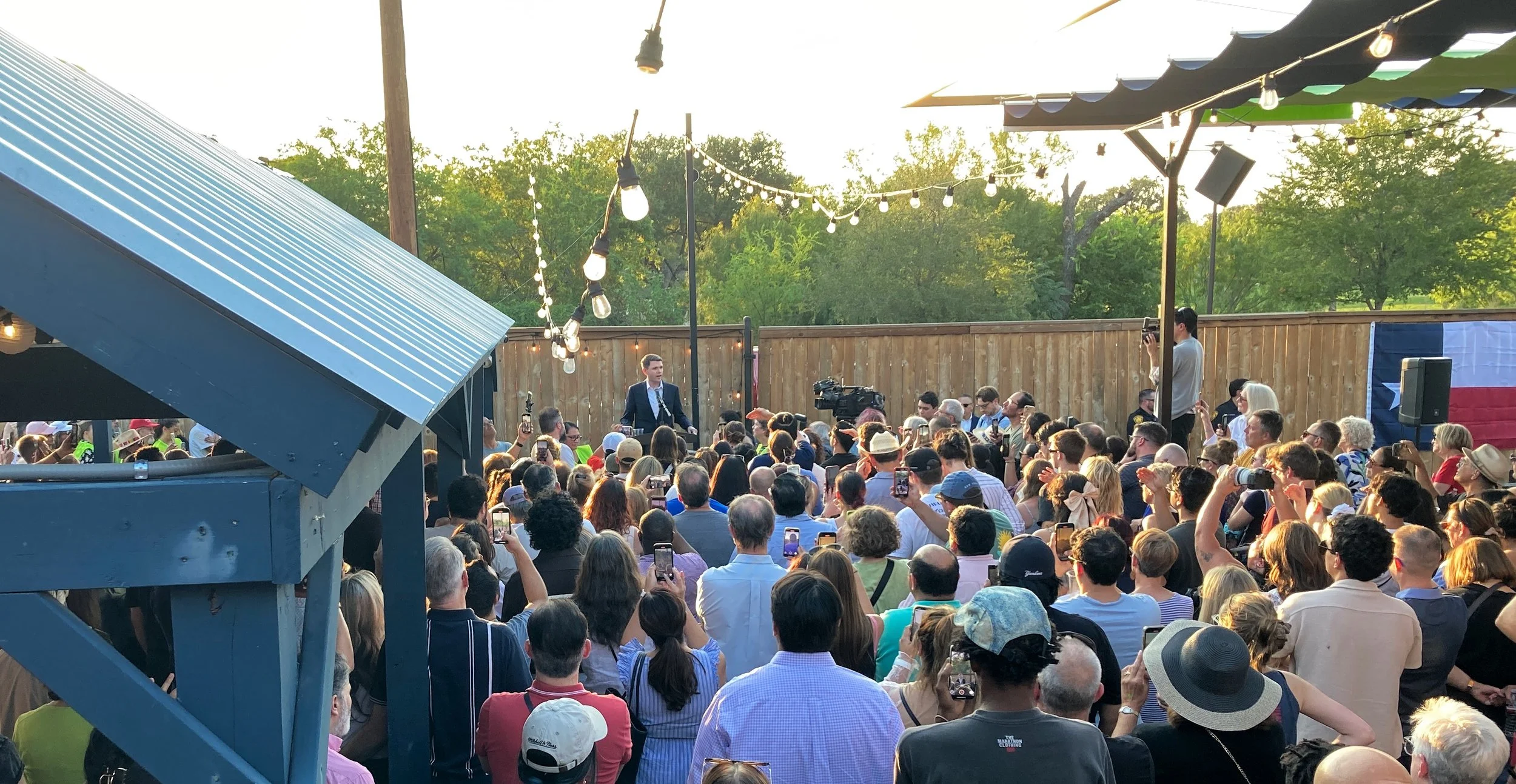

Texas Senator-Elect James Talarico campaigning in September 2025. Credits: H. Michael Karshis, CC BY 4.0, via Wikimedia Commons

Similarly, El-Sayed, a former public health doctor, emerged as a champion of the party’s left, earning the nickname ‘Mini-Mamdani’ after catching fire for his Medicare for All campaign, propelling him ahead of Republican Mike Rogers even after Haley Stevens, his rival in the Democratic primary and closely tied to the pro-Israel lobby, endorsed Rogers just two days before polling. The party’s left won again in Maine, where former logger and trade unionist Troy Jackson, endorsed by Bernie Sanders, unseated five-term Republican incumbent Susan Collins.
In North Carolina, which Trump carried by three points in 2024, the popular former governor Roy Cooper became the state’s first Democrat senator since Kay Hagan lost her seat in 2014; former Paralympian Josh Turek flipped Iowa’s open seat; the paediatrician Annie Andrews defeated Darline Graham, sister of the late Lindsay Graham, in South Carolina; and Sherrod Brown, backed by the trade unions, won back his former seat in Ohio from Jon Husted.
Tuesday’s results raise serious questions about the remainder of Trump’s term, but also about the Democratic Party itself. With Trump still in the White House, Congress can be expected to pressure Trump into a resolution to the war with Iran; investigations into the unreleased Epstein files and allegations of corruption will also certainly go ahead, with the possibility of articles of impeachment being brought forward against Trump and / or senior members of his administration.
For the Democrats, their sweep occurred in the context of a tenuous coalition of progressive and moderate candidates, the former growing quickly. The Democratic Socialists of America look set to seat eight of its rank in the new Congress, several of whom already unseated moderate Democrats earlier in the year, alongside many more endorsed by progressive figureheads Alexandria Ocasio-Cortez, Zohran Mamdani and Bernie Sanders.
Moreover, the triumphs of Abdul El-Sayed and Troy Jackson in Michigan and Maine respectively demonstrate that progressive Democrats can win in competitive elections, which makes them a growing threat to the party’s establishment. Even outside of the party’s progressive wing, it cannot be denied that victories in key races were delivered by populist outsiders, such as Adam Hamilton, James Talarico and Jon Ossoff in Kansas, Texas and Georgia respectively, who distanced themselves from the party’s establishment. Whether Hakeem Jeffries and Chuck Schumer keep their places at the helm of the party in the House and Senate come January is now an open question, as questions abound over the ideological makeup of the expanded Democratic caucus in both chambers.
Big Tech and the AI infrastructure boom were among the largest stories of the election season. Opposition to AI data centres is now popular across the political spectrum, driven primarily by concern over air and noise pollution and the rising cost of water, electricity and memory chips; all but one or two of the forty-odd local ballot measures to ban, pause or restrict new data centres passed. Elon Musk, the richest man in the world and among the principal backers of AI infrastructure, spent close to half a billion dollars on Republican campaigns this year, with voters across the country emphatically rejecting a great majority of the candidates funded, including MAGA outsider Ken Paxton in Texas, where the largest share of Musk’s money was directed.
Many prominent Democrat victors, El-Sayed among them, made opposition to AI buildout and regulation of the industry central to their campaigns. AI stocks, already in decline before the election, sold off heavily as investors weighed what Democratic control in Congress and the states would mean for data centre construction, with the Nasdaq dropping more than five per cent in a single session on November 5th, its worst day in 19 months and talk of a bursting ‘AI bubble’ returning. Democratic control of Congress, together with gains at state and local level, may bring the rapid buildout to an end, and raises questions of whether AI companies would receive government bailouts should they continue to remain unprofitable.
The midterm elections may prove a watershed moment in American history, leaving Trump effectively a lame duck for his two remaining years in office, with his power far more subject to Congressional scrutiny. The Democrats will now have complete legislative control in twenty-two states and control the governor’s mansion in thirteen out of the fifteen most populous states, having significant implications for policy on AI, healthcare, clean energy and transgender rights across the nation.
The scale of the blue wave reflects two years of anger at a corrupt administration that oversaw a spiralling cost of living and another war in the Middle East. Victories in Congress and state legislatures, across swing states and Republican strongholds alike, will embolden Democrats and raise their hopes for the presidency in 2028. Nevertheless, the Democrats that won these elections look different from the one that lost in 2024, carried as it was by a new generation of populist candidates who will challenge its establishment. As the new Congress convenes and the 2028 primaries approach, the ideological fissures between its moderate, liberal and progressive wings can only be expected to widen. The coming few months will give us an idea into which figures emerge from different factions, all of which will be seeking to be the party’s presidential nominee in 2028.