
Bathwater Shows Us the Art of Refusing Closure
I left Bathwater frustrated.
Photograph by Ayeley Hudson
Not by its quality (it was the most mature student play I have ever seen) but by its refusal to resolve. Every relationship Avi (the protagonist) builds remains suspended, unresolved, dripping like residual bathwater slowly, reluctantly tumbling into the chasm of a pulled plug. That frustration sent me back to speak with writer Sam Asher Misan and co-director Eva Cotton. I was brilliantly compelled, hungry to understand why a play about coming home offers no homecoming at all.
Here's the premise: Avi lives in London as an artist, in a self-imposed exile from his Jewish family who he fled from the week before his Bar Mitzvah. Eight years later, he’s broke, adrift in a state of artist block. In the absence of his family, he found surrogates in his art dealer/ lover, Maxim and his painting of a mermaid.
But the mermaid has no face.
He calls home begging for money. His mother's condition is brutal. Come back. Finish the ritual you abandoned.
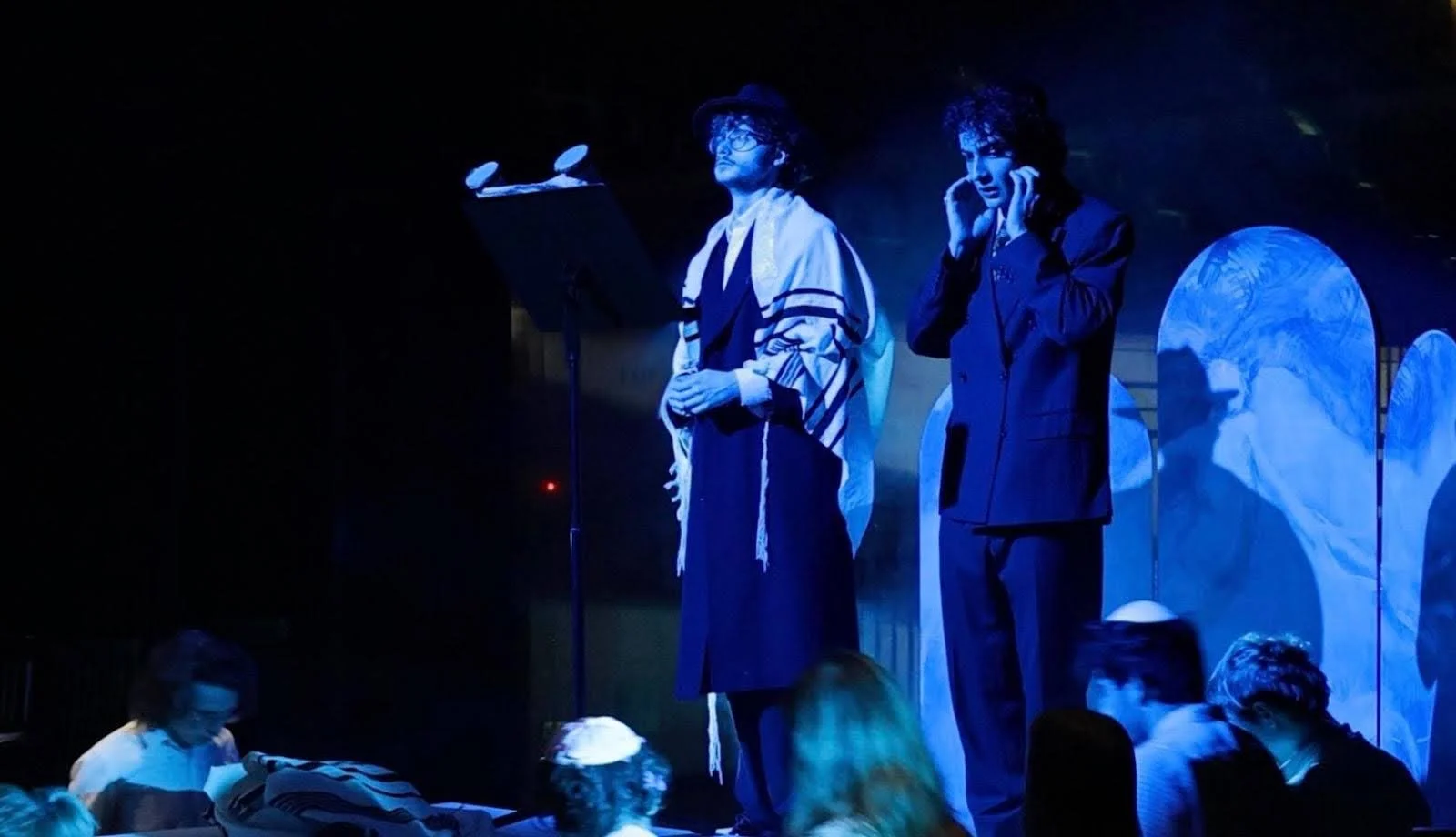
Avi returns to find everything changed. His sister Miriam has married into Orthodoxy, which Avi doesn’t recognise and a family who sit as strangers in their own home since Avi’s absence. What unfolds is less reconciliation than excavation. Every attempt to connect reveals another layer of unbridgeable distance.
This leaves gaps that surrogates try and fail to fill, with therapy from Richard, religious teaching by Rabbi Zali, advice and romantic intimacy from Maxim (Avi’s art dealer) all failing to speak in Avi’s language.
As an audience member, I felt both shocked and inspired by Bathwater. The play explores "the stories we tell ourselves to survive", Misan tells me. Sometimes we lie to protect others, sometimes to protect ourselves. Sometimes surrogate love, as important as it can be, may never redeem the scars left from paternal connections.
Bathwater masterfully navigated this complicated entanglement of familial and surrogate relationships through understanding that although surrogacy cannot always supplement, it can used as a form of survival in familial absence.
In the play, Avi uses his surrogate connections: Maxim, Richard and Rabbi Zali, in different ways, as survival mechanisms. Avi’s surrogates fail to provide the love his parents refused him. It’s this dilemma that gives Bathwater such a profound emotional pull.
“Bathwater masterfully navigated this complicated entanglement of familial and surrogate relationships”
I resonated with Avi’s visceral frustration with his surrogates. I've been estranged from my mother. I understand that whilst we cannot choose our families, we absolutely choose who steps into their absence. For Avi, he chooses Maxim (played by George Lammiman). His art collector-turned-lover, who generously allows Avi and his mermaid to live with him. The tenderness at the exposition shown by Maxim towards Avi starkly juxtaposes the congealed, manufactured intimacy by his Jewish family. With Maxim, Avi is cheeky, self-assured and expressive, with his family Avi is perpetually frustrated and impatient. Surrogates can provide a safe space for self-expression, where the prescriptive unit of the household cannot.
Rabbi Zali is perhaps the most heartbreaking surrogate. Max Parkhouse, who skilfully played the role, describes Zali as written as ‘a surrogate Father figure, who tries (and fails) to reignite Avi's faith’. Zali's role extends beyond Bar Mitzvah preparation; he's attempting to guide Avi's entire ethical formation. Parkhouse characterises Zail in a dynamic balance between serious spiritual counsellors and a fun, eccentric jester-like figure. As the play progresses, rather than Avi’s parents, who lash out against his petulant ways, Zali recognises Avi is a broken child and treats him with a playful, teasing, dynamic paternity. Watching their relationship unfold was heartwarming but also bittersweet, knowing that Rabbi Zali would only support Avi to the extent that he engaged with Judaism.
Parkhouse faced challenges in Zali’s character arc, and balancing ‘an assertive authority who is also playful and puckish in his love of Torah’, creating comedy without tipping into caricature. Acting as both a form of comedic relief and a cautionary tale, the performance achieves something remarkable. Zali's earnest Talmudic enthusiasm becomes both touching and a source of comedic relief for the audience, yet it falls short for Avi and his inquisitive, provocative nature. His love for Torah cannot translate into the language Avi speaks. Watching Misan "convert the comedy into affective pathos as the play drew on," as Parkhouse puts it, you see the production's central heartbreak. Surrogates and their good intentions are crumbling under their own weight of unmet expectations.
Richard, the therapist, represents professionalised care, in the form of art psycho-therapy. His clinical, yet creative frameworks, attempt to translate trauma into artistic expressions. As an audience member, it was poignant to see flashbacks to Avi’s therapy sessions as a child, where his child-like curiosity foreshadows the approach he later brings to his surrogate relationships. Whether learning new Torah stories/ Hebrew words with Rabbi Zali or quipping about the art world with Maxim.
Each surrogate offers a different vocabulary for pain: physical intimacy, therapy, and religion. None can bridge the fundamental gap of absent familial love.
Cotton’s musical compositions and sound design makes this fragmentation visceral. She wanted to create a "sonic signature for the domestic sphere", sampling dripping water, gurgling pipes and scraping chairs, beneath snatches of lines from previous scenes and half-remembered melodies.
“None can bridge the fundamental gap of absent familial love.”
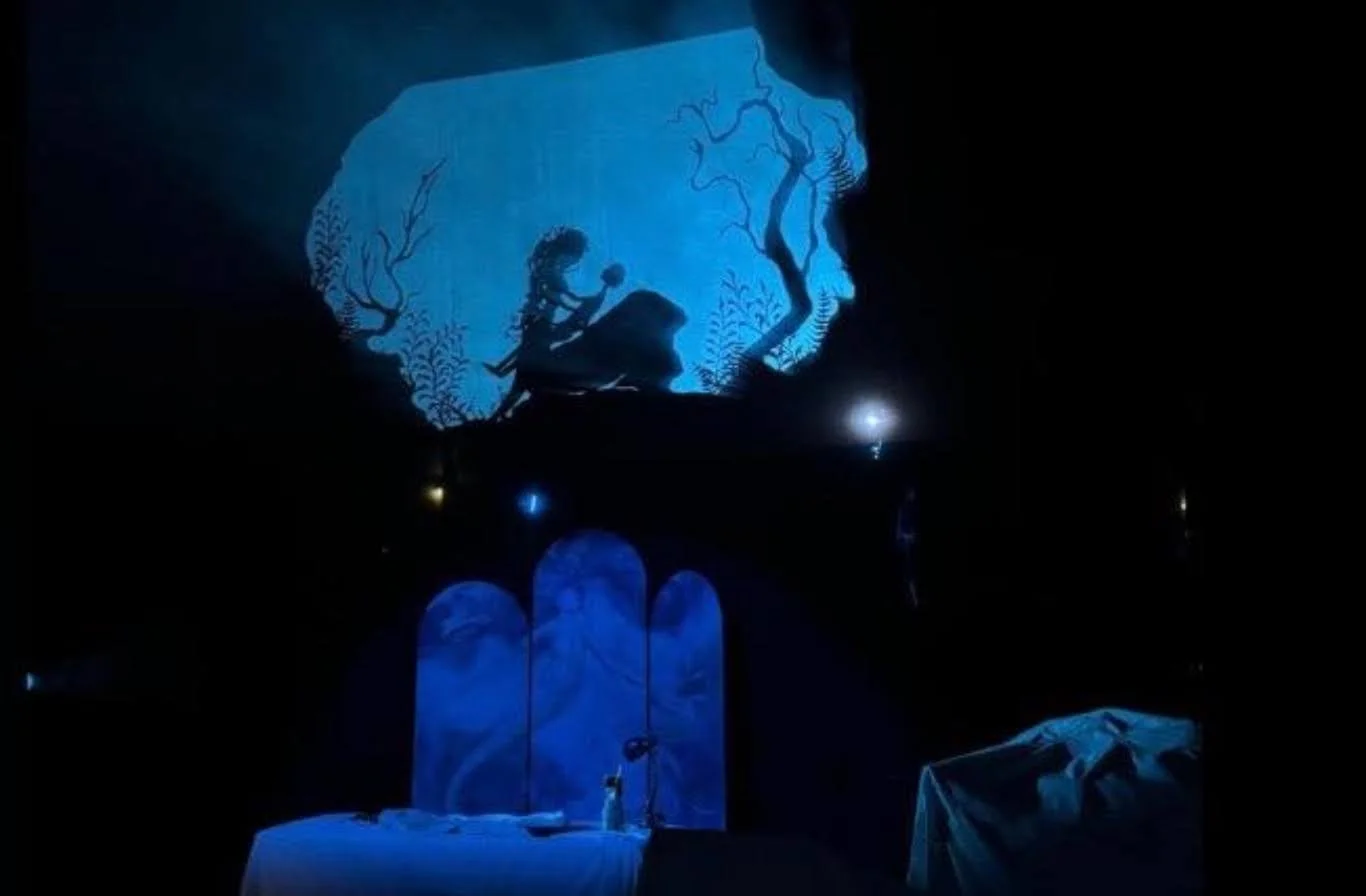
The production's ambition is staggering. The Bar Mitzvah scene exemplifies this reach. In this scene, the stage’s back wall rises to reveal a vast auditorium. Here lights were rigged beneath bleachers to turn the raked seats of the auditorium into a coral reef. Half-illuminated figures process between the empty auditorium rows. Alongside this, a custom-made shadow puppet animation is projected onto the gauze that hangs above the dream-like scene, accompanied by a live choir performing Hebrew liturgy. Co-director Eva Cotton acknowledges that achieving this scale and coordination in 4 weeks was a challenge, particularly in a small, intimate black box theatre space.
Photograph by Ayeley Hudson
In our interview, Cotton describes Misan’s text as deeply “rich in symbolism and key signifiers that come back again and again". The challah, sheitel wigs, water, paint, tefillin, the chiming of cutlery, the mermaid painting, the bath, in tandem to build a rich set for a play with naturalistic dialogue, maximalist visuals and surrealist elements. Bathwater’s mix of naturalism and surrealism mostly lands, though some symbolic elements become too abstracted. The production’s emotional core always rings true and stems from deeply personal territory. Misan discusses feeling "alienation from my own culture". Whilst Avi has been away from his family for eight years, Misan himself was raised within Judaism but felt excluded from it as a queer person. As a Sephardic Jew, the differences within Jewish communities were never fully explained to him. He wanted to "represent that confusion on stage". Being simultaneously an insider and an outsider to one's own heritage, that's what drives Avi's desperate search for interpreters.
The play's refusal to resolve stems from Misan's understanding of buried trauma. When secrets surface, he explains, "there's a very quick peeling of all these layers at once". This results in conversations where people cannot see one another's perspectives because they've become so married to the different stories they have told themselves. Without ever reaching a mutual understanding, a resolution cannot be reached. A dynamic that plays out between Avi and every would-be caregiver.
"Writing a play really forces you to consider other people's perspectives," Misan reflects. You can see this in his treatment of characters who fail Avi, not from malice but from their own wounds. "For me, the moments in the play that resonate the most are when I relate to the characters' flaws." That vulnerability prevents the work from becoming mere indictment.
Parkhouse reflects that every relationship in the play, including Zali and Avi's, is "left unresolved". Yet he imagines his character "still pottering about, Talmud in hand". A would-be father still searching for the right text to reach his lost spiritual son. It's an image that captures what Bathwater understands: the borrowed love we construct cannot change the past, but it can provide solace, shelter, maybe even hope in the present.
My frustration hasn't gone anywhere. However, it has shifted and become complicated by understanding what Misan and Cotton are deliberately withholding. Some returns don't lead to reconciliation. Some families, biological or constructed, never quite bridge the distance, however much love exists in the attempt.
And that’s okay.
Bathwater was so enchanting, so compelling, so resonant to me because it reminded me that belonging need not be external. It can come from oneself. From the rich, internal world we have within ourselves. Avi found solace through his imagination, his paintings, where his mermaid painting represented an ultimate surrogate mother, a safe haven. For me, dancing has given me the sense of belonging that family couldn’t.
Bathwater refuses comfort. What it offers instead is recognition. And that feels truer. It feels more uncomfortable yet reassuring. Knowing that drawing from within, one does not need to be without. Although we cannot always choose our family or be entirely satisfied with surrogates, we can build a home within ourselves.