
Old Money, New Reading at the ADC’s Great Gatsby
I was looking for the party, I found the morning after.
F. Scott Fitzgerald's The Great Gatsby is perhaps the most seductive trap in the American literary canon, a novel that glitters and blinds you, binds you to it’s own rot. Director Tally Arundell promises immersion in her programme notes, and on that count, she delivers. The painted backdrop of Doctor T.J. Eckleburg's watchful eyes bleeds into murky greens and blues, impressionist brushstrokes dissolving the boundary between audience and the moral wasteland of West Egg and East Egg. Hats off to the set designer Abilgal Lemans for taking the audience beyond watching the Jazz Age. But how far were we really transported?
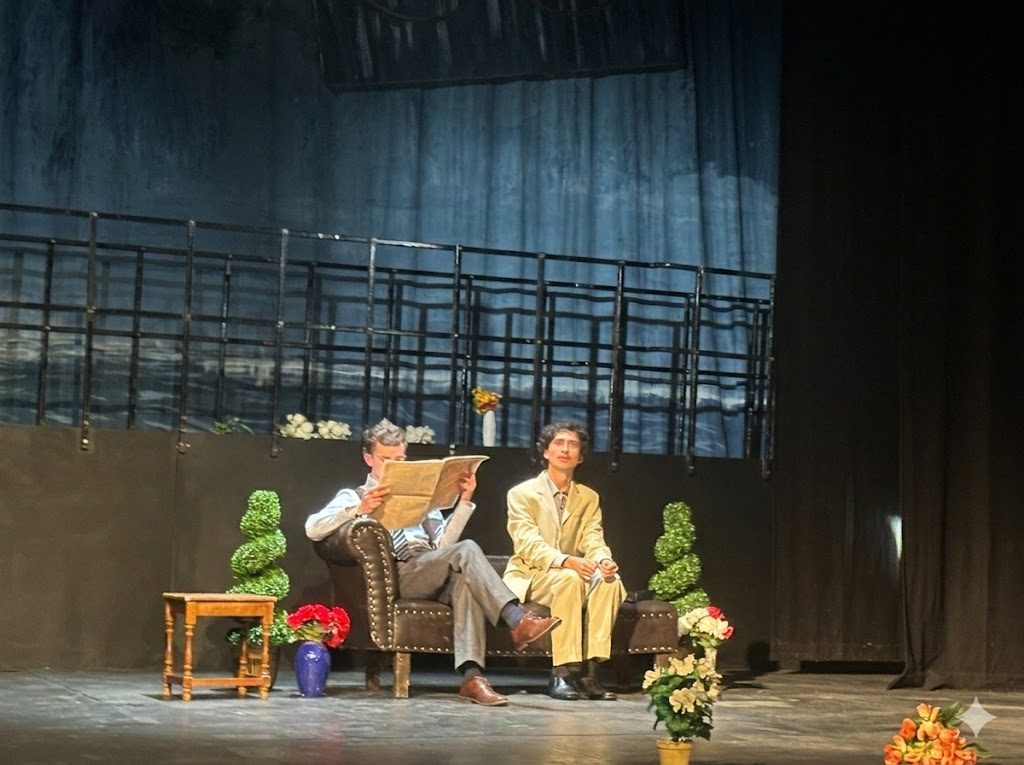
The band deserves special mention. They give this production all the chutzpah of the roaring twenties, the woozy, humdrum delirium of an era drunk on its own excess. Paired with costumes that are genuinely dazzling- flapper dresses beguiled with jewels, fitted suits of a gentlemanly persuasion, there are moments where the aesthetic ambition of show dazzled the brightest. A moment of mastery between the production value of the show and performance was when Gatsby (played by Eddie Lunchmun) strips from his suit to his swimming costume. The vulnerability of the gesture lands with quiet precision, a man shedding his invented self, stitch by careful stitch, before meeting his tragic demise.
Nick Carraway is the emotional spine of the evening, and the performer (Nick Danby) carried this weight with impressive depth, composure and persuasion. Tom, too, is a force: clenched fists, flushed face, a temper that made me shift in my seat. Felix Warren clearly took seriously Fitzgerald's insistence that Tom is no cartoon villain, and the performance rewards that commitment. Myrtle (Violet Chereau) is the revelation of the night: purposefully provocative, economically precarious, vital. The Wilson-Myrtle confrontation is the most salient scene in this adaptation, where domestic violence, adultery, and class anxiety collide with the social critique Fitzgerald embedded in every page. Wilson (Michael Mundove) emanated an earnestness of economic difficulty, that provided a strong juxtaposition to the sickening excess of the West/ East Eggs.
And yet. For all its visual and musical splendour, this production makes a curious interpretive choice: it seems less interested in the wealth divide that is Fitzgerald's central obsession than in reframing its women. Daisy (Mia Lomer), in the novel a creature of deliberate, weaponised fragility, a "beautiful little fool," is rendered here as sensual, vivacious, almost strategic. The line is delivered with sarcasm rather than wilful self-erasure, which is a bold reading, but one that quietly dismantles Fitzgerald's critique of old money's carelessness. "Her voice is full of money," one of the most damning lines in American fiction, lands as an afterthought, a pretty penny, rather than the entire bank vault the novel builds toward.
“it seems less interested in the wealth divide that is Fitzgerald's central obsession than in reframing its women.”
The spatial limitations of the ADC stage occasionally work against the production's ambitions. The ensemble dancing feels overcrowded, the choreography swallowed by too many people, undermining the very excess it aims to conjure. Jordan Baker (played by Mina Strevens) held a strong stage presence at times yet needed more authority, both in physicality and accent, to sell the blase aristocratic detachment the character demands. Meyer Wolfshiem (Thomas Gladstone), too, drifts in the peripheral vision of the play when he might have anchored his criminal underbelly with greater menace, if he had been given more stage time. Also, if Wilson had more stage time there would have been a strengthened, visceral sense of economic injustice that runs centrally throughout the novel.
Gatsby himself is performed with real commitment, though the voice at times leans toward the declaratory, when intonation and hesitation might crack the armour more effectively. The "gods honest truth" moments feel occasionally too polished. Gatsby's tragedy lives precisely in the cracks beneath the surface, the 17-year-old boy still haunting the invented man.
There is much to admire here. The poignant image of Daisy and Gatsby gazing across the water. The shirt scene, naturalistic, tender, genuinely joyful and playful. Nick's retrospective vignettes, laced with regret, deepen the tragedy without overplaying it. When the production trusts its quieter instincts, it finds Fitzgerald's green light flickering at the end of the dock.
In this production, the green light still flickers. Just not quite bright enough.