
‘Moral Clarity’ Does Not Describe the Iran War
US-Israeli aggression is being conducted with no constraints
In a speech to the UN General Assembly, Mike Waltz, the US ambassador to the UN, described this spiralling US-Israel War against Iran as a “moment of moral clarity”. However, the seeming disregard for the consequences muddies this view. The US-Israeli strikes have initiated a war where the justifications seem an afterthought, an amalgamation of different framings that the Trump administration cannot seem to quite settle upon. The rhetoric of “moral clarity” supposedly driving US actions comes as the bombs are being dropped. The emerging narrative is that the US and Israel acted pre-emptively against an “imminent” Iranian threat. Simultaneously, the war seeks to “save the Iranian people” by creating a potential for regime change.
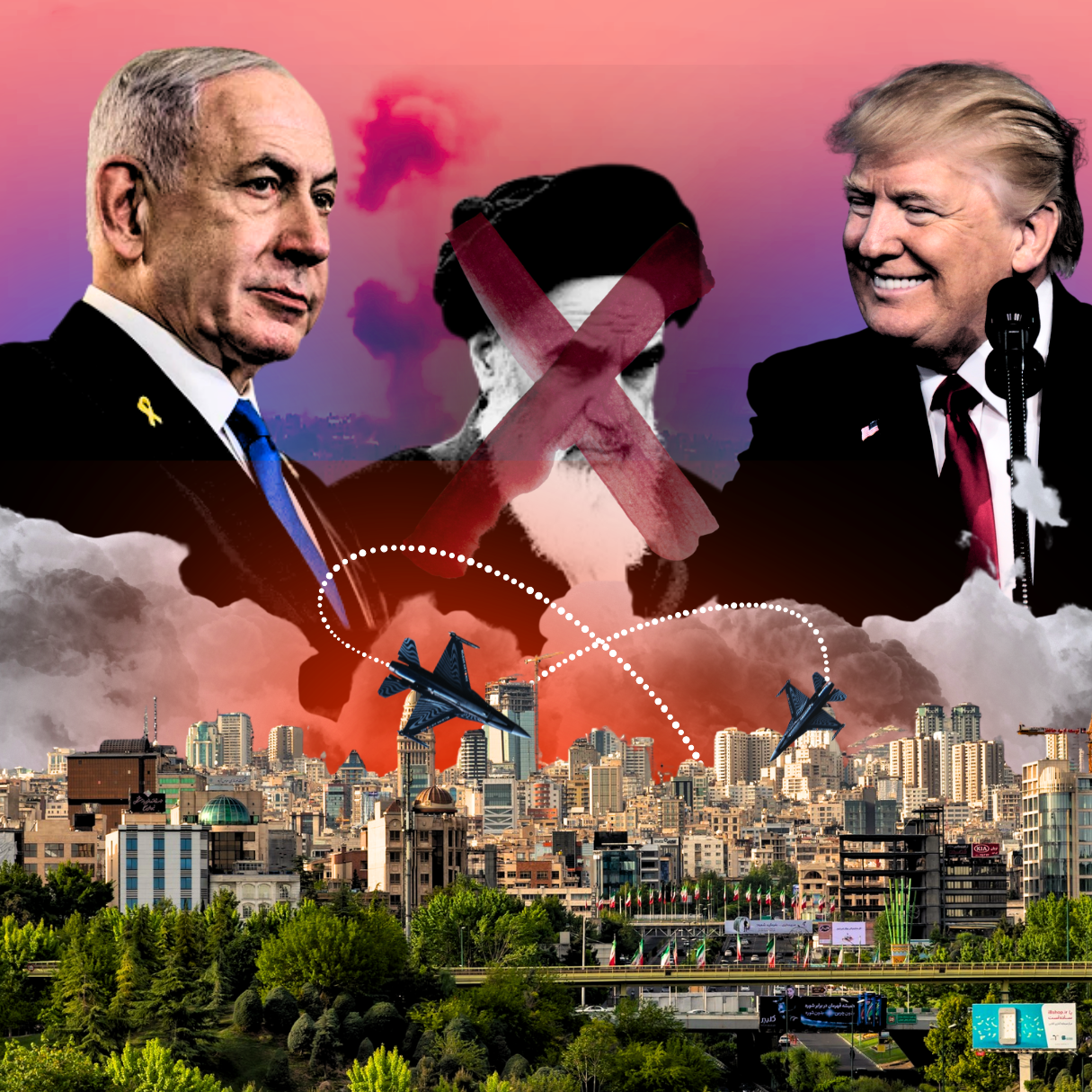
During the biggest anti-government protests in decades in late December 2025, Trump promised Iranians that “help is on its way”. The thin legitimation of this war has rested, partially, on this promise. The current war is presented as retribution for the killing of thousands of Iranians by the regime. More than 7000 deaths have been confirmed, with 11,000 more under investigation, according to the US-based human rights group, HRANA. Tens of thousands more were arrested or injured. Trump urged the Iranian people to prepare to overthrow the clerical establishment: "When we are finished, take over your government. It will be yours to take. This will probably be your only chance for generations."
“The justifications for the attacks seem an afterthought, an amalgamation of different framings”
Iranians Are Not a Monolith
As news broke of Khamani’s assassination on Saturday evening, Iranians in the country and across the diaspora celebrated. For Iranians living for nearly half a century under a repressive, violent, and theocratic regime, the death of the 86-year-old Supreme Leader, in power since 1989, has been a moment of catharsis.
There is a sense of justice being delivered. A large part of the diaspora is composed of dissidents – many in LA, who fled with the Shah regime in the late 1970s. Many Iranians would have spent time in the prisons of the Islamic Republic, some tortured, and a large part of the second-generation Iranian diaspora and children raised amongst these stories. Justice is thus intergenerational. These are communities in forced exile. The death of Khamenei is a moment of joy and possibility that, in a best-case scenario, could allow them to return to their homeland, reunite with family members, and envisage a democratic liberal Iran. This commingled sense of justice, hope, and unfurling potential must not be dismissed.
“This commingled sense of justice, hope, and unfurling potential must not be dismissed.”
While this is a very obvious point – that there is diversity and disagreement amongst Iranians – there is often the tendency when discussing Muslim populations to homogenise; the “Iranian people” have been reduced to a monolith that has obscured, perhaps quite intentionally, the nuances of the debate. It is, unequivocally important to have at the centre of this debate Iranian voices, however, as with every diaspora, people are saying different things. Moral clarity cannot be achieved by “putting aside the politics” to listen to the singular voice of “Iranians”. This war is not apolitical, and neither are the Iranian people.
The Long Shadow of the Shah
For Reza Palevi, the son of the last Shah, who was deposed in 1979 by the Islamic Republic, the next few weeks are pivotal. During the protests in January, across Iran and the diaspora people rallied under the monarchist flag. Pahlavi has lived in LA for decades and is heralded by some protesters as the rightful King and future leader of Iran. Many thus welcome the intervention. Pro-Palavi Iranians in the UK have celebrated the death of Khamani by flying the Shah-era flag alongside the flag of Israel.
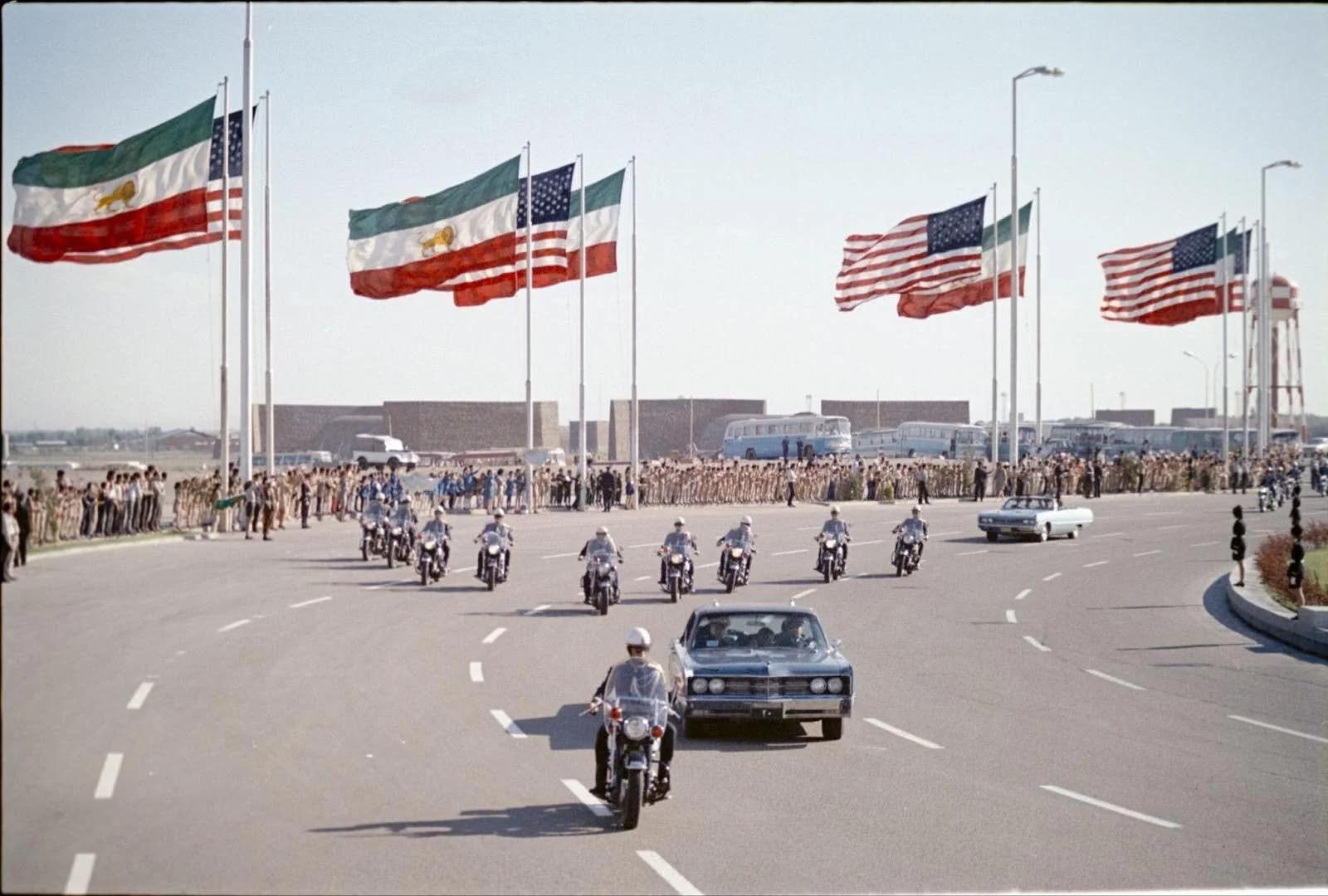
Nikon’s 1972 trip to Tehran
There seems to be a growing amnesia of the violence and discontent during the rule of the last Pahlavi; the last Shah widely used torture against dissidents, meanwhile repeated US and British interventionism and huge wealth inequalities caused mass protests that were violently suppressed.
While corruption and political violence, especially against Iranian women, are of a different scale under the Islamic Republic, it is important to remember that the revolution of 1979 was a mass uprising of Iranians composed of both marginalised religious groups and pro-democracy leftist protesters. Recent Iranian history is not a binary between the Shahs and the Ayatollahs – the latter inherited much of the state, security, and bureaucratic apparatus from the former. The adoption by some Iranians of Shah-era insignia does not entail a wholesale support for a return to the monarchy. During a messy and leaderless movement, Iranians in the December protests who held up the lion and sun flag of the Shah dynasty are not by default giving their consent to an interventionist war to violently reimpose a regime that collapsed several decades ago.
“Iranian history is not a binary between the Shahs and the Ayatollahs – the latter inherited much of the state, security, and bureaucratic apparatus from the former.”
Reza Pahlevi has propagated this ‘either–or’ framing between the Islamic Republic and a Shah-ist Iran. Pahlavi is close to both the Netanyahu and the Trump administration and has markedly not spoken out on the genocide in Gaza. Iranians within the diaspora who celebrate the death of Khamani whilst also expressing a wariness about US-Israeli intervention have been criticised as regime-apologists and human rights deniers or, from the other side, as pro-Zionists. This is the same destructive logic that has paralysed the Western world into enabling a genocide in Gaza; you are either pro-Israel or pro-Hamas, and positions between, or condemnatory of both, are silenced.
Furthermore, pro-Pahlavi Iranians are not representative of the entire “Iranian people”. As residents in the West, they have a much greater platform and media access. However, within Iran, the ongoing internet blackout makes it difficult to discern Iranian public opinion. We do know that there have been very real displays of mourning. While others celebrate, thousands gathered in the squares of Tehran to mourn Khamani’s death.
One university student, in Mashhad, Iran, said, “I am ready to sacrifice my life for Islam and for my imam Khamenei. The Zionist regime and Trump will pay a heavy price for the martyrdom of my leader”. The instinct to resist is “notoriously deep” in Shia Islam, the ideological core of the regime and the religion to which the majority of Iranians belong. For the deeply pious, Khameni’s death has been interpreted as the fulfilment of an “martyrological script” – an “idealised closure” to political life through sacrificial death.
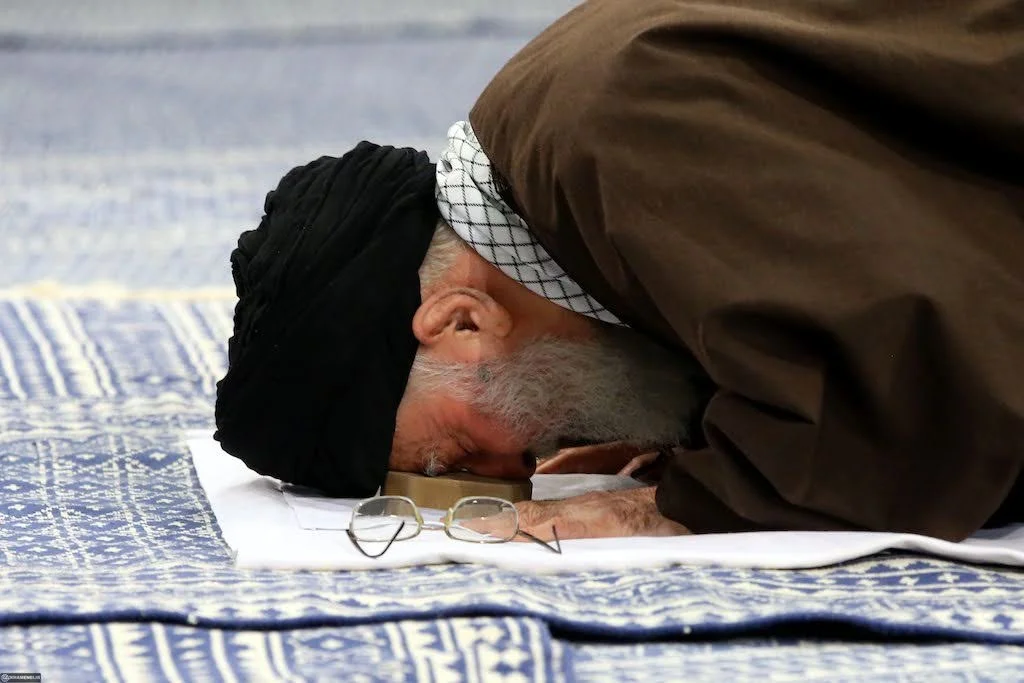
Ayatollah Khamenei praying, February, 2017
“Saving Iranians”, Or Strategic Opportunism? The Intentions Behind the Rhetoric
In judging the “moral clarity” of this war, the intention of the aggressors matters. It matters what the imagined outcome of that action is, and if it is an outcome believed to bring about good and good for whom.
The global perception of this conflict does not fit into a uniform narrative. The raid of the US embassy in Karachi, Pakistan, suggests the attack upon Khamenei has been perceived as an attack upon Shi’ites, and for some, Muslims globally. In a decade where geopolitics has been marked by the genocide in Gaza, it is no wonder that some fold this war into a neat narrative of Western aggression upon the Muslim world.
Even if “saving the Iranian people” is the ostensible goal, there is a discrepancy between the assertion and the means through which it is being achieved. In US-Israelis strikes across the country, as of March 6, 1332 Iranians have been killed according to Aljazeera . Upwards of 165 girls were killed in early strikes on Minab school, southern Iran. Just days later, Melania Trump spoke to the UN Security Council on the importance of protecting children’s education.
The school was situated near an Islamic Revolutionary Guard Corps (IRGC) barrack. Here, the same deadly logic that has underpinned the genocide in Gaza emerges: it is morally justifiable to kill Palestinians, for the Palestinian people to be collateral, if their hospitals are built over Hamas tunnels. These deadly means are justified by a greater ‘end’ – the destruction of the Islamist “axis of evil”, be it Hamas, Hezbollah, or the sponsor, Iran.
There is a deeper hypocrisy to claims that Trump is saving Iranians. While the Islamic Republic bears partial responsibility for the economic crisis due to extensive corruption and economic mismanagement, it is the US sanctions that have been crippling. Ordinary Iranians have primarily suffered, with the sanctions, converse to the stated intent, largely emboldening the IRGC and their monopolies upon smuggled imports.
However, even more so than the wars upon Iraq and Afghanistan, there is thinness, or even carelessness, to justifications of the war that centre on the “liberation” of Iranians. Trump, in his Monday address, has laid out the objectives that did not mention the recent protests or human rights. Trump intends to “destroy Iran’s missile capabilities” and “annihilate their navy”. Peter Hegseth stated that the US has no plans for a democratic transition. As the war has unfolded, the “Iranian people” have slipped from the discourse of the Trump administration.
For the second justificatory frame, it is neither reasonable nor a valid legal argument that this war is “preemptive” against an “imminent” and “existential” Iranian threat against Israel. Khamaeni, in the last few days, has been described as “one of the most evil people in history” by Trump, and a “threat to all of humanity” by Netanyahu. This language of ultimate values, humanity, and eschatological evil is wielded to justify escalatory military action.
Marco Rubio said that the strikes were triggered by Israeli plans to attack Iran; the US acted “preventively” since Iran would respond by attacking US bases. Economic crisis, mass demonstrations, and a steady empowerment of Israelis relative to Iran – demonstrated by the losses during the 12-day war in June 2025 – has placed the regime in a position of unprecedented weakness.
Strategic opportunitism is likely to be driving the war – Israel is acting because Iran is so weak, with an intent to keep Iran weak. The war has been driven partly to permanently shift the balance in the region decisively in Israel’s favour through the crumbling of Iran into civil war and regionalism. For Benjamin Netanyahu, this latest war is part of a broader resort to militarism and bellicosity for his political survival ahead of the upcoming election.
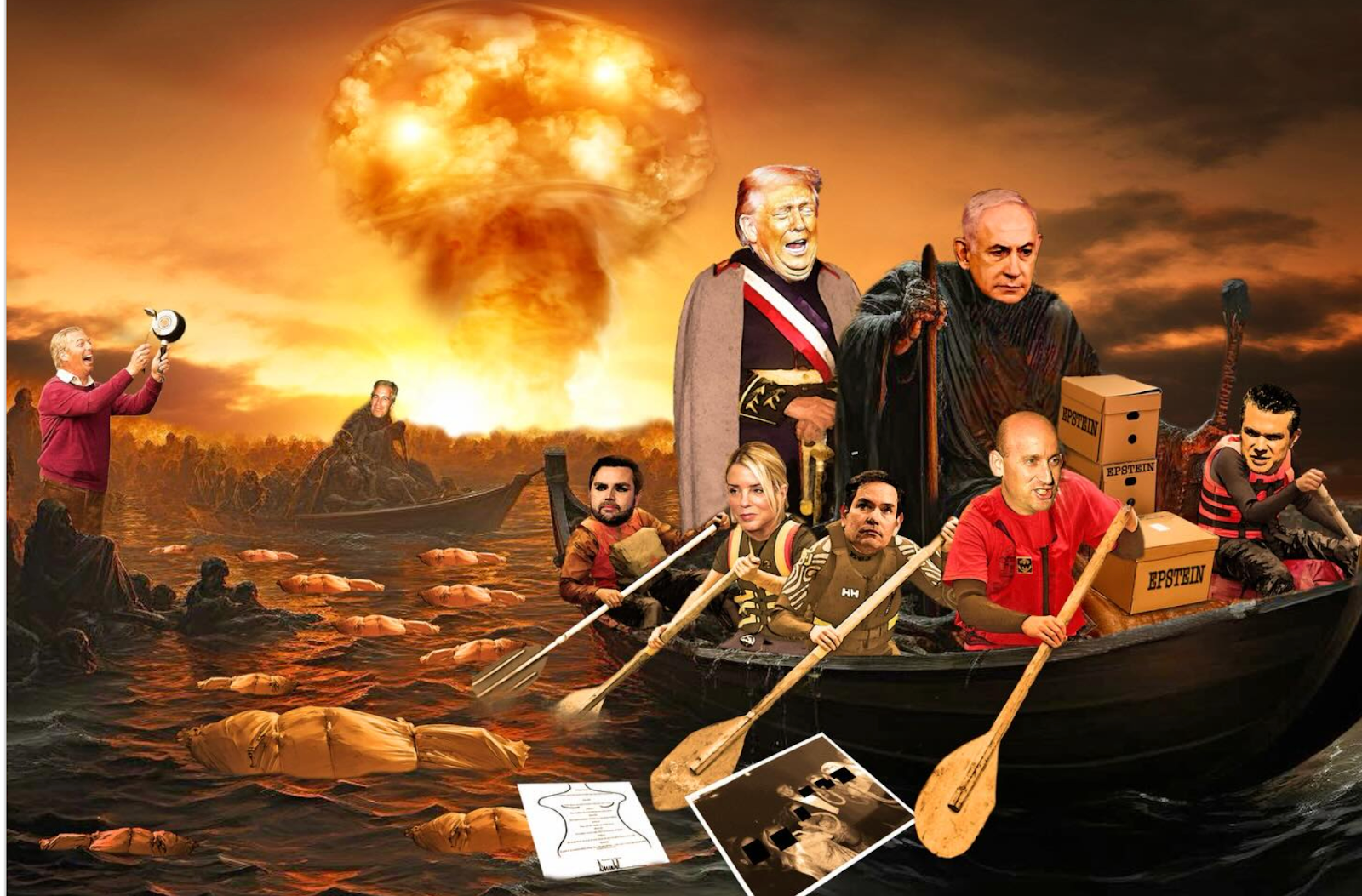
@ cold war steve
Will the Regime be Toppled? The Result is Uncertain
Betting that the assassination of Khamenei will topple the regime and allow a less repressive alternative seems like a wild and reckless gamble. The Islamic Republic has operated for decades with a resilient IRGC security apparatus, business-elite networks, technocratic class, and civil bureaucracy, held together by repression and an entrenched ideology of resistance and religiosity. The Islamic Republic has lines of succession in place, with a three-strong interim leadership. Hardliners remain in positions of power, their anti-Western stance likely reinforced. What is possible, then, is that the regime survives under a different leader. Under conditions of war, the regime may conduct an even more repressive campaign at home, particularly against ethnic minorities.
“Under conditions of war, the regime may conduct an even more repressive campaign at home, particularly against ethnic minorities.”
Yet the hold of the Islamic Republic across the whole territory seems tenuous. Iran has launched a wave of attacks upon Israel, aligned countries, and US military bases across the Middle East. These have included Gulf states, and particularly Oman, which has had a crucial role in mediating between Iran and the US. Professor Ali Ansari describes Iran as “concussed”, acting seemingly against strategic interests, and potentially, without a clear command or control over all its military units.
The seeming lack of any forward planning conjures memories of intervention into Libya in 2011. The US and allied invasion of Iraq and Afghanistan were failed nation-building projects. In contrast, in Libya, after the NATO-backed troops killed Muammar Gaddafi, the country tipped into an ongoing civil war. This war against Iran may, in the worst case, entail a collapse of the entire state and a descent into regionalism, factional infighting, and war. The Baluch, Kurds, and Arabs, who for decades have been repressed and marginalised under an aggressively Shi’ite Farsi-speaking state, may use this opportunity to launch insurgencies and stake separatist claims, which the US and Israel seem to be encouraging. Similar to the Syrian Civil War, localised neighbourhood militias might appear. Violent “wars of the elites” may follow over the leadership vacuum.
This is a vision where “cash does not come out of the machines, bread does not get made, the revolutionary courts are destroyed, the prisons are sprung open and ethnic groups stake their claim”. For the far-right forces within the Israeli government, a divided and crumbling Iran seems an ideal outcome.
Yet the toppling of the Pelavi dynasty took time; protests began in 1977, only by 1979 did Rohall Ali Khomenei, the founder of the Islamic Republic, assume power. It took until the end of the year for order to be established. We are less than a week into this war, and the possibilities are vast and unpredictable.
How Will the Dust Settle?
The current war is looking increasingly like a plan to reshape the geopolitics of the entire Middle East. Israel, and the Gulf states have been bombed by Iran. The Strait of Hormuz may be closed and could spark a global oil crisis. Israel has launched a ground invasion into Lebanon and Trump has not ruled out boots on the ground. Israel has enacted its latest siege upon Gaza, threatening two million Palestinians, once again, with a hunger crisis.
European countries seem likely to be dragged into the war, despite its demonstrable illegality. In the UK, bitter memories of the Iraq invasion are recalled. Following the Starmer government’s initial deer-in-headlights response, the UK has agreed to US use of British airspaces for defensive action.
If the Islamic Republic survives, in any form, it seems unlikely that it would ever re-enter nuclear negotiations, given that now, twice in the last decade, America has pulled out of talks and entered into war regardless. Nuclear weapons may seem more attractive – a means to forestall future Israeli aggression.
Carl Schmitt, in 1932, warned that when a state invokes humanity to justify its war, the word “humanity” is confiscated and monopolised. The conduct of the war “can thereby be driven to the most extreme of inhumanity”. Claims of “moral clarity”, universal good, and just purpose can set the foundations for some of the most extreme and destructive conflicts – as the war in Gaza has so grievously demonstrated.
The means through which the US and Israel are conducting the war, their justifications, and their rhetoric are far from morally explicable. Within the Iranian diaspora, and those who are claiming to speak for ‘Iranians’, it is perhaps the desire to be “morally clear” on this war that is obscuring so much history, nuance, and diversity of perspectives. During war, people will be killed, and justifying this for a certain end, however grand or just, cannot absolve responsibility. Khamani’s death can and should be celebrated, but the heightened hostility across the region will inevitably have to be reckoned with.