
Sustainable Fighter Jets? Critics Say Cambridge Institute Offers Corporate Green Cover
According to their website, the Cambridge Institute for Sustainability Leadership works to “transform economies for people, nature and climate” and to “accelerate action for a sustainable future”. They represent the University of Cambridge at COP, the annual multinational climate conference. Their staff include environmental scientists and former NGO leaders. However, an analysis of their partners and clients troubles this narrative, calling into question the institute’s approach to environmentalism through their ties to controversial companies.
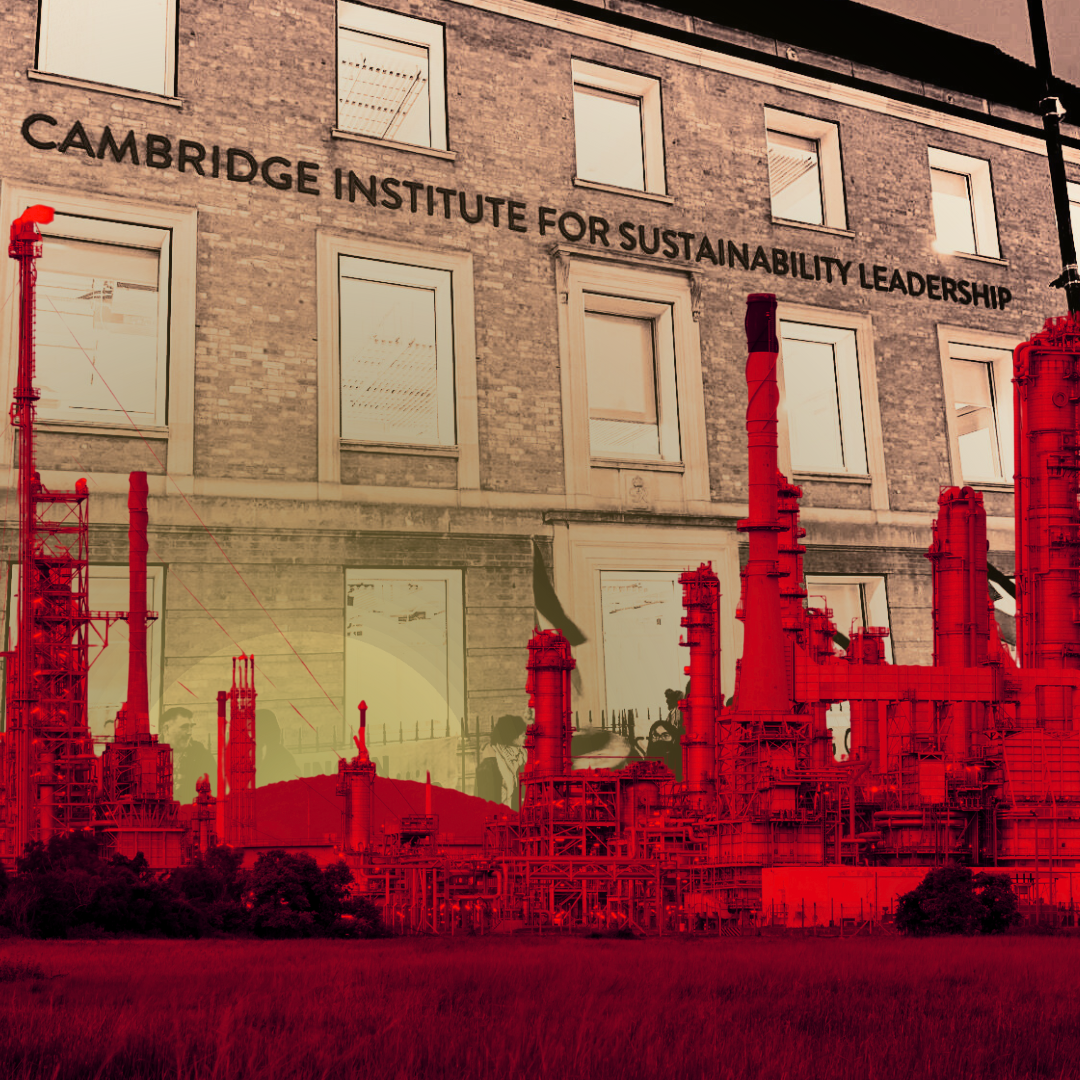
Students and local campaigners have been increasingly critical of the Institute’s work, with some critics calling it “greenwashing”. On the other hand, a CISL representative told TCS that their “approach is to push for system-level change by working with the organisations – including major businesses – that have the ability and responsibility to shift whole markets.” So, are CISL doing the necessary work of positively engaging with influential businesses, or are they providing a positive face for carbon emitters?
Environmentalist campaigner and journalist Venetia La Manna defines greenwashing as organisations or businesses engaging in “behaviour, activities or marketing to make us believe that they are doing something for the benefit of the environment, usually in a bid to make us buy more.” As La Manna notes, the term originates with oil companies’ marketing strategies, but has been extended to cover a wide range of corporate activities such as H&M’s “Conscious Collection”. CISL evidently engages in sustainable action - such as the development of the energy efficient Entopia building where the organisation is housed. However, beyond the institute’s immediate headquarters, their relationships with paying companies have reason to raise concern.
Analysis of CISL’s partnerships provides some justification for this description. One key channel of engagement with corporations is through “Corporate Leader Groups”: groups that corporations can pay to join, ostensibly to create political pressure for “the transformation to competitive, sustainable, inclusive economies”. However, notably, Coca-Cola is a member of all three CLGs ( European, UK and African). This close relationship is demonstrated in CISL’s reports, wherein Coca-Cola receives frequent positive mention. CISL has also produced media presenting Coca-Cola’s corporate strategy as dedicated to net-zero. However, the company remains the world’s largest plastic polluter and recently dialled back its environmental commitments. Meanwhile, it is subject to international protest against its water theft, supply chain injustices, use of paramilitary violence and operations in occupied Palestine.
A CISL spokesperson told TCS: “We only work with companies when we believe there is credible potential for meaningful change, and we are transparent about our expectations: aligning with science, ending harmful practices over time, and enabling fair and sustainable economies. We also recognise that students and campaigners are right to scrutinise this work.”
Other CLG members pose similar problems. Partners Amazon, Dow, LaFarge, Unilever, Heathrow and H&M have all been the subject of widespread criticism for their harm to the environment. South 32, a mining company and CLG Africa member, is involved in a Trump-backed plan to expand mining in Alaska by building new roads through protected Indigenous lands. Until recently, Total Energy - the oil company responsible for large-scale fossil fuel expansion in East Africa - was listed as a partner in the CLG Africa. After a series of scandals, including a French court ruling finding TotalEnergies guilty of ‘greenwashing’, CISL has since removed Total from the website. Despite this, as of November 2025 they list ongoing work with fossil fuel company BP.
Is ‘Green Growth’ a feasible strategy?
It sounds reasonable - as CISL argues - that engaging with these companies is necessary work. If we can reform these big polluters, surely we have a shot at preventing further environmental disaster? However, this reflects a particular perspective on the relationship between the environment and economics. CISL advocates for “green growth”: which frames economic expansion and resource use as potentially compatible with sustainability through environmentally oriented policies and practices.
Economist Jason Hickel is one of many academics who critique this approach, arguing that green growth as ‘a dominant policy response to climate change and ecological breakdown’ cannot work given ‘emissions reductions in line with 1.5°C are not empirically feasible except in a de-growth scenario.’
An example weakness of a ‘green growth’ strategy can be found in the work of CISL partner Anglo American. This relationship runs deep, dating back at least to 2010. Until recently, a significant part of Anglo American’s activities included coal mining. In a move heralded by the company - and by CISL - as a green innovation, they recently moved their focus to platinum and other minerals. Undoubtedly, these minerals are a part of the creation of alternatives to fossil fuel economies. However, groups in the areas mined by Anglo American have pointed to the continuity of violence experienced in their communities. Whether it is coal or platinum being mined, rivers and land are polluted and people are exploited. What’s more, the benefits are disproportionately experienced in the Global North: while we in the UK get to enjoy “green” energy systems and electric cars, communities in Peru, Chile and South Africa lose access to land, water and power at the hands of the same companies.
This issue further extends to CISL’s Aviation Impact Accelerator project. Launched in 2020, the AIA aims to “[map] net-zero aviation pathways providing insight across the industry”. Given the extensive carbon emissions of the aviation industry, this is certainly an understandable priority. However, CISL’s approach is focused not on industrial degrowth strategies but on technological and policy changes: of the four strands of their 2030 Sustainable Aviation Goals, not one focuses on reducing the number of flights. It must be noted that AIA’s partner organisations include Heathrow Airport, Emirates Airline and Flexjet private jet company.
Green Warfare and Sustainable Fighter Jets
The AIA is also CISL’s key point of contact with another industry: weapons manufacturing. The arms companies Boeing and Rolls-Royce are listed as “contributors and funders” to the project. Rolls-Royce is a global producer of engines for tanks and military planes. Meanwhile, Boeing is the world’s 4th largest arms company. Both companies have been involved in the supply of arms to countries committing human rights abuses in Palestine, Yemen and Sudan. In 2023, CISL commended the “extensive sustainability improvements” made at Rolls-Royce’s Bristol site, where parts for F-35 fighter planes are manufactured.

© Crown Copyright 2014 Photographer: Cpl Paul Oldfield
“Both companies have been involved in the supply of arms to countries committing human rights abuses in Palestine, Yemen and Sudan.”
Researcher Okopi Ajonye identifies a broader trend in which arms companies, state militaries and universities collaborate to produce “Militarized Environmental Technologies” - seeking to reduce the environmental impact of military activities, while simultaneously “greenwashing” the fundamentally unsustainable business of war. Arguably, the “greening” or warfare suggests a vision of a climate future that depends on the expansion of militarism. The Climate Change Performance Index states if all global “militaries were a country, they would be the fourth largest emitter in the world.”
‘Green’ Intergenerational Wealth
CISL further makes efforts to establish connections with some of the world's wealthiest individuals - running a yearly residential for those experiencing “Multi-generational wealth”. CISL suggests that “families who steward wealth, business and influence” are positioned to lead action in the face of climate and environmental collapse. For the sum of £13,695 (accommodation not included), “impact-focused families” burdened with hereditary riches can spend five days in Cambridge learning how to sustain their family’s businesses in a “safe environment”.
As Venetia La Manna notes, the climate crisis is closely linked to global inequality. The wealthiest global 10% - a group that includes most University of Cambridge students - are responsible for almost half of total lifestyle emissions and two-thirds of global heating since 1990. This imbalance deepens among the top 1% and beyond, whose high-consumption lifestyles, such as frequent private jet use, vastly exceed the global norm. Moreover, wealth inequality enhances climate vulnerability. In this context, CISL’s summer school for affluent participants could be seen as a form of greenwashing - both presenting an image of climate responsibility and offering reputational cover for those contributing most to the problem.
What bigger picture is revealed by this overview of CISL’s partnerships? Their ongoing ties with corporations like Coca-Cola and Anglo American call into question the effectiveness of their environmental project: are CISL promoting genuine change or simply providing strategies for the social legitimation of continued environmental abuses? Such a possibility demands that students, staff and community members take a critical approach to environmental projects and messaging both within the university and beyond. We do not have to accept the status quo when it comes to academic engagement with the environment. Alternative models such as the work of Goldsmith’s Forensic Architecture team on environmental racism are being developed, challenging structures of academic-corporate engagement. Given this, it is our collective responsibility to stay critical, and to seek and promote environmental strategies and messages that uplift marginalised voices and contribute to a genuinely just future.