Linguistic Purity Is Always Invented: Newspeak for the 21st Century
For MP Rupert Lowe, in a recent facebook post, Britain’s ultimate enemy are those ‘almost incapable of speaking English’, promising to purge England of foreigners and their languages through mass deportations. This linguistic fixation might sound absurd – until you realise echoes of the idea surface in unexpected places. Take Anglish: a project to “purify” English by scrubbing out foreign words and restoring its Germanic roots. How are we to take this conlang – a playful thought experiment for word nerds, or a fantasy of linguistic bloodlines?
The fracture lines showed when the Anglish subreddit erupted over an article from the Southern Poverty Law Center asking if the whole idea was racist. The fallout was swift: splinters of alt-right revivalists on one side, self‑declared “non‑politicals” on the other. In the wreckage, a bigger question remains – does making a language more ‘pure’ have fundamentally ideological consequences?

We must, however, remember this rare left wing fighter in the Anglish Civil War
Perhaps we can find the answer in history. Unlike natlangs (languages that slowly evolve over centuries), conlangs – or constructed languages – are built from scratch. A single person or a small group defines the conlang’s vocabulary and designs the grammar, ensuring that it is coherent and linguistically sound. Some are made just for fun, or for art’s sake; others are created to bring whole new worlds to life. Think of Sindarin from The Lord of the Rings or Dothraki from Game of Thrones – languages imagined into existence to imbue those fantasy worlds with authenticity. But not every conlang started as a work of fiction. Some were born out of big, idealistic dreams such as Basic English, a language designed to make communication simpler, clearer, and more universal.
Behind the idea for Basic English was Charles Kay Ogden, a British linguist and philosopher. Winning a scholarship at Magdalene College, Cambridge – in 1908, Ogden began his undergraduate study in Classics. During his student years, he founded The Heretics Society – a society for free-thinking debate – and launched the Cambridge Magazine, which gave voice to some of the brightest minds of the day. Yet, his longest lasting legacy was not a publication or club, but a language: Basic English. Between 1925 and his death in 1957, Ogden made promoting Basic English his life’s mission. To spread his simplified version of English across the world, he even established the Orthological Institute in 1927, right on King’s Parade in Cambridge – a fitting home for a man determined to make words work harder and smarter.
At its heart, Basic English has the admirable aim of efficiency through purity. It is a stripped-down version of the language we all know, comprised of just 850 carefully chosen words and five simple rules that, together, could replace some 20,000 ordinary English words. Intended to aid teaching English as a second language, Ogden believed that with this minimalist toolkit anyone could say almost anything, anywhere in the world. Essentially, Ogden tried to simplify English while retaining familiarity for native speakers, particularly by specifying grammar restrictions and a controlled small vocabulary. Notably, he only allowed 18 verbs, referring to them as “operators.”
However, purifying a language has unintended consequences. In The Shape of Things to Come (1933), H.G. Wells imagines a utopian future facilitated by Basic English as a universal lingua franca. Yet beneath his vision of harmony lies something unsettling: the uniformity uniting society makes it frighteningly easy to control.

Like Wells, George Orwell initially admired Basic English, viewing the conlang as a clever way to simplify communication and encourage mental clarity. But Orwell’s perspective shifted after the Second World War, and he became vastly critical of universal languages. Basic English undeniably left a mark on Orwell, influencing the conlang Newspeak in his novel 1984. The story follows Winston Smith, an ordinary man trying to stay sane under the watchful eye of the Party – a government that knows everything. With telescreens in every room and hidden microphones on every corner, privacy is practically extinct. But Orwell’s real warning is not just about being watched, it is about being silenced.
In 1984, the Party invents Newspeak, a conlang designed to shrink people’s vocabulary and, with it, their ability to think freely. Newspeak is constantly being refined, often resulting in eradication of words from the vernacular. Syme, one of Winston’s coworkers in the Ministry of Truth, is a lexicographer working on the eleventh edition of the Newspeak Dictionary. He theorises that: “By 2050 [...] The whole literature of the past will have been destroyed. Chaucer, Shakespeare, Milton, Byron – they'll exist only in Newspeak versions, not merely changed into something different, but actually contradictory of what they used to be. [...] Even the slogans will change. How could you have a slogan like Freedom is Slavery when the concept of freedom has been abolished?”. The Party’s aims extend beyond limiting speech and thought – Winston proposes that “2 + 2 = 5” is the perfect symbol of the Party’s power, since its ultimate goal is to manipulate universal truths by controlling what is articulable. Words like ‘freedom’ and ‘rebellion’ simply vanish. Over time, so do the ideas behind them. The logic is chilling: if you can’t say it, you can’t think it. The Party even insists that Newspeak should be spoken in a quick, clipped rhythm with short words, no frills, no emotion. The goal? To make speaking so automatic that critical thought never even gets the chance to form.
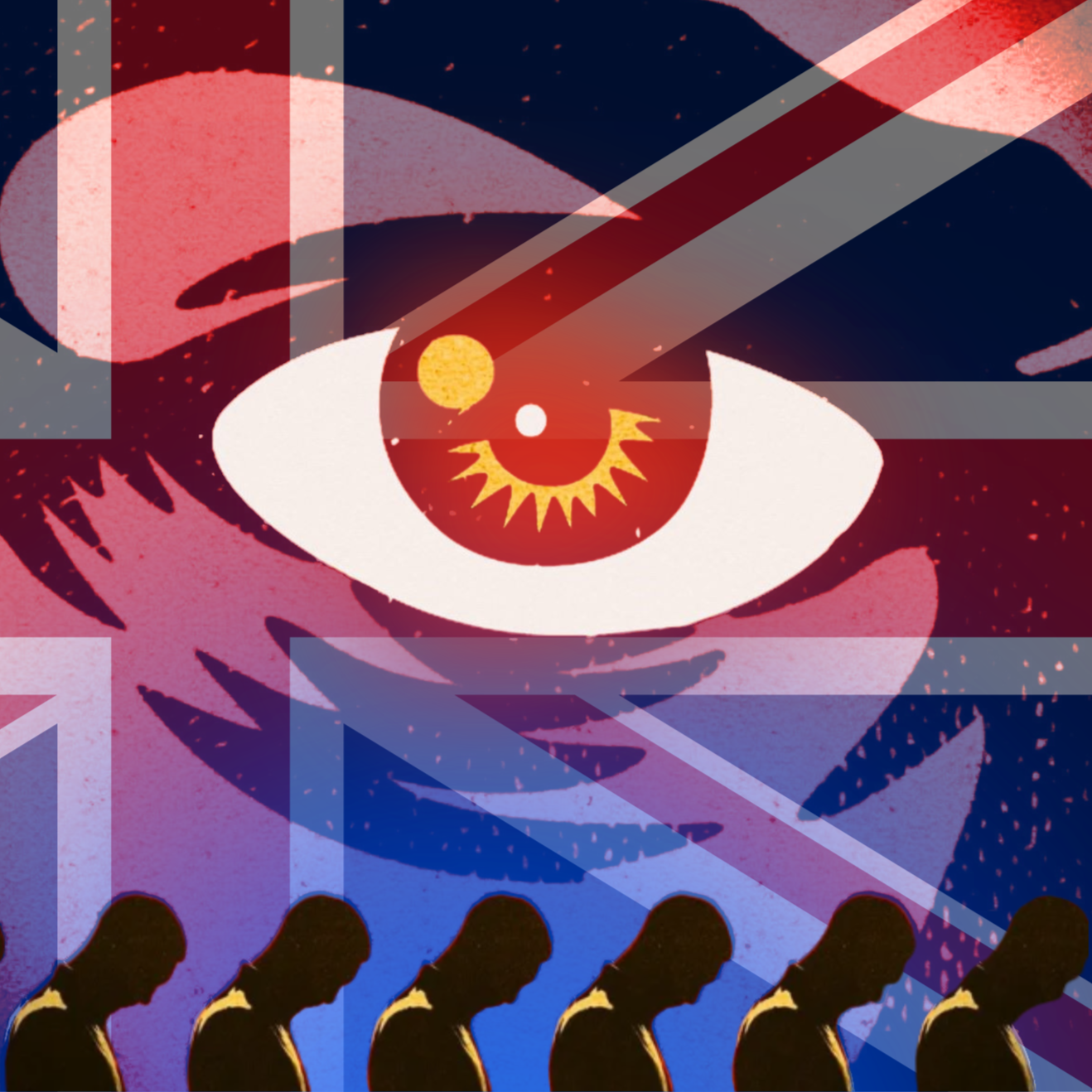
In the end, Charles Kay Ogden’s dream of uniting the world through a simpler language found an unexpected critic in Orwell. What began as a hopeful tool for clarity became, in Orwell’s eyes, a cautionary tale. Basic English may have inspired Newspeak, but Orwell turned it inside out by transforming a vision of unity into a chilling reminder that whoever controls language controls thought.
The perils of conlangs resonate into the 21st century with the construction of systems like Anglish: a version of English that prefers native words to those borrowed from foreign languages. Initially coined by Paul Jennings in his satirical 1966 Punch articles, the term ‘Anglish’ has since been taken up in earnest by conlang hobbyists on Reddit. Anglish is now a manifestation of linguistic purism, an ideology rooted in the belief that languages should be kept ‘pure’, untainted by foreign influences which bring about ‘undesirable’ changes. By replacing words such as ‘native’ with ‘inborn,’ famous’ with ‘nameknown,’ and ‘dictionary’ with ‘wordbook’, Anglish’s creators hope to maintain what they consider to be the sacred integrity of an ‘original’ English language (further examples and common words can be found here). The conlang consists of vocabulary mainly derived from old Germanic languages: Anglo Saxon, Old English, and Old Norse. Indeed, the definitions of Anglish found in its official Reddit page include “English as though the Norman invasion had failed” and “English that avoids real and hypothetical French influence from after 1066”, which support a mythologised notion of a ‘pure’ English language.
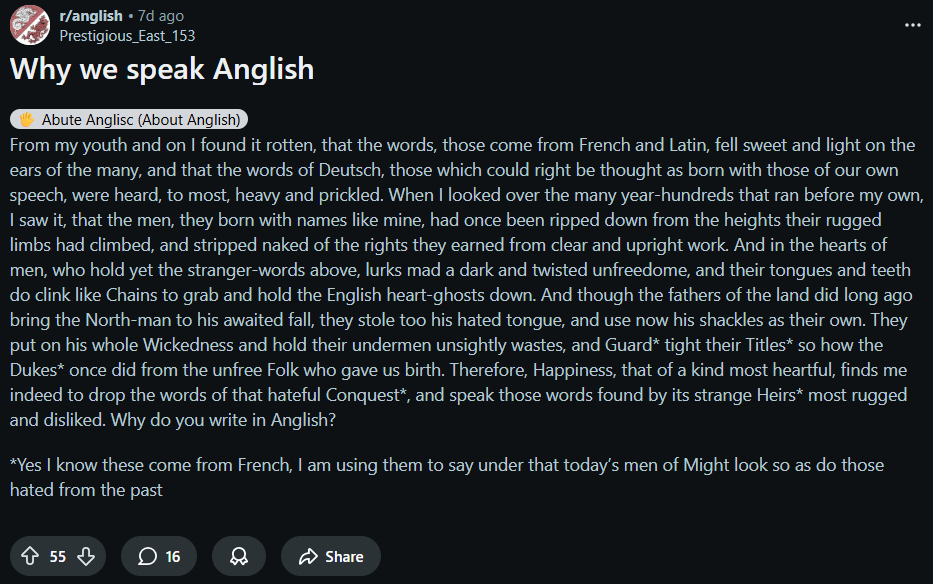
This user struggles to criticise the French without using French words.
Despite the Reddit page’s assertion that “extreme purism is discouraged”, this has not prevented white ethnonationalists from transforming the conlang into a vehicle for exclusionary identity politics. Romanticising the idea of this ‘pure’ linguistic alternative, as opposed to the multilingual melting pot that is English, Anglish has done considerable harm in strengthening resentment and hatred towards minority groups. As early as 2010, Anglish was “casually discussed in places such as Stormfront”, one of the largest neo-Nazi Internet forums. Whether in language, politics, or art, the message is clear – foreigners and their influence in the West will be met with hostility, alongside a desperate attempt at erasing their historical impact.
Orwell’s scepticism of universal, purified languages finds renewed urgency when confronted with the stifling impulse of the modern British far-right. Keen to erase our island’s linguistic diversity, and to curtail social debate to its most reductive terms, they try to claim a ‘pure’ English that has never been just ours. Our rich history of loanwords – from French beef to Arabic algebra – is a testament to our history’s fundamental diversity. To use English as a measure of exclusion, forgets the English of the anti-slavery Abolitionists, the English used to write the 1955 Anti-Apartheid Freedom Charter, and to draft the Universal Declaration of Human Rights. With dialects and creoles encompassing 1.4 billion speakers across the entire planet – English has a fundamentally global heritage.